

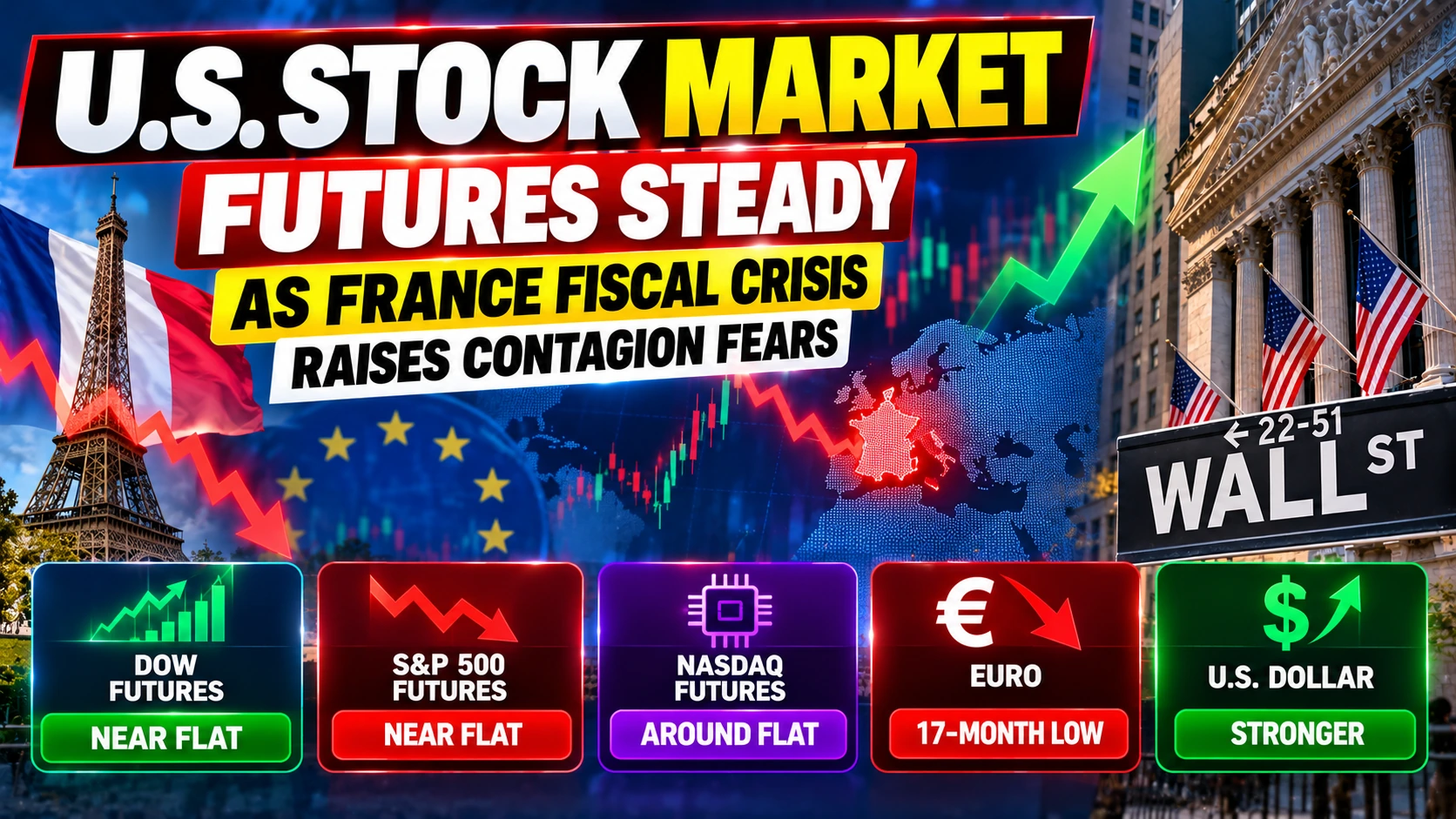
U.S. Stock Market Today: U.S. stock markets entered Monday, October 5, 2026, on relatively steady footing despite growing concern that France’s fiscal problems could spread across European financial markets.
Early in the session, futures tied to the Dow Jones Industrial Average and S&P 500 were little changed, while Nasdaq futures were also near flat. That resilience followed strong U.S. stock gains on Friday, when weaker employment data reduced expectations for another near-term Federal Reserve interest-rate increase.
The calm in U.S. equities contrasted sharply with developments in Europe. French government debt concerns pushed the euro to a multi-month low, increased the risk premium on French bonds and revived questions about whether fiscal stress could spread to other highly indebted European economies.
Here is what investors need to know about the latest U.S. stock market outlook, France’s debt concerns, Treasury yields, the euro and Federal Reserve expectations.
U.S. Stock Futures Hold Steady Despite Global Uncertainty 🇺🇸
Wall Street futures showed limited movement before the opening bell.
Earlier trading indicated that Dow and S&P 500 futures were around flat to slightly negative, while Nasdaq futures were little changed. Investors appeared to be balancing two competing forces: growing fiscal uncertainty in Europe and expectations that weaker U.S. economic data could encourage the Federal Reserve to take a more cautious approach to interest rates.
As regular trading progressed, the picture remained mixed. The Dow was lower in early trading, while the S&P 500 edged higher and the technology-heavy Nasdaq gained around 0.5%.
This relative stability suggests that investors were not treating France’s problems as a full-scale global financial shock—at least for now.
Global Markets at a Glance 📈
Global Markets at a Glance
U.S. stocks remain resilient while European fiscal concerns, elevated bond yields and currency volatility keep investors cautious.
Investors balance changing Fed expectations against rising European fiscal uncertainty.
Wall Street remains relatively resilient despite growing uncertainty across European markets.
Technology-sector resilience continues to provide support despite elevated bond yields.
French fiscal and political concerns are weighing heavily on confidence in the common currency.
Global Market Performance
Key assets and the forces currently influencing sentiment
| Market / Asset | Direction | Sentiment | Primary Driver | What Investors Should Watch |
|---|---|---|---|---|
🇺🇸
Dow Futures
U.S. Equities | → Near Flat | ● Neutral | Fed expectations vs. European fiscal concerns | Interest rates and global risk appetite |
📊
S&P 500 Futures
U.S. Equities | → Near Flat | ● Stable | Resilient U.S. investor sentiment | Treasury yields and economic data |
💻
Nasdaq Futures
Technology | → Around Flat | ● Resilient | Technology and AI-sector strength | Long-term yields and tech valuations |
💶
Euro
Currency | ▼ 17-Month Low | ● Bearish | French fiscal and political uncertainty | France’s bond market and eurozone sentiment |
🇫🇷
French CAC 40
European Equities | ▼ Under Pressure | ● Cautious | Debt and political uncertainty | French borrowing costs and fiscal policy |
💵
U.S. Dollar
Currency | ▲ Stronger | ● Positive | Euro weakness and elevated U.S. yields | Fed expectations and currency flows |
🏦
U.S. Treasury Yields
Government Bonds | ⚠ Elevated | ● Watch | Interest-rate and inflation expectations | Fed policy and economic releases |
Market Risk Dashboard
Important themes shaping global investor sentiment
Rising borrowing costs and political uncertainty remain important European market risks.
Elevated long-term yields can pressure equity valuations and borrowing conditions.
Euro weakness and dollar strength could influence multinational earnings and global capital flows.
Major U.S. indexes remain relatively resilient, although rates remain an important risk.
Wall Street Is Calm, but Global Risks Are Building
U.S. equities are showing relative resilience even as France’s fiscal concerns pressure European assets and the euro. The most important signals to monitor are French government bond yields, U.S. Treasury yields, the euro-dollar exchange rate and changing Federal Reserve expectations.
👀 What to Watch Next
Why Is France’s Fiscal Situation Worrying Markets? 🇫🇷
France has become the centre of global market attention because investors are increasingly concerned about government debt, budget deficits and political uncertainty.
The country’s proposed 2027 budget has intensified scrutiny of its fiscal position. At the same time, political divisions could make meaningful spending reforms difficult to implement.
One of the clearest warning signals has appeared in the government bond market.
The yield gap between French 10-year government bonds and equivalent German Bunds—a closely watched measure of perceived risk—has widened to levels not seen since the eurozone debt crisis era.
French long-term borrowing costs have also moved close to the psychologically significant 5% level.
Why Higher Bond Yields Matter
Government bond yields influence borrowing conditions throughout an economy.
If investors demand higher yields to hold French debt, financing can become more expensive. That pressure can eventually affect corporations, households, banks and government spending.
Higher yields can also make bonds relatively more attractive compared with stocks, potentially pressuring equity valuations.
What Does “Contagion Risk” Mean? ⚠️
Financial contagion occurs when problems originating in one market, country or financial institution begin affecting others.
The concern is not simply whether France faces higher borrowing costs. Investors are asking whether similar questions could emerge around other European governments.
Spain has also entered the spotlight after Prime Minister Pedro Sánchez called an early election, adding another layer of political uncertainty.
If investors begin demanding substantially higher risk premiums across several eurozone economies simultaneously, European financial conditions could tighten more broadly.
However, contagion is a risk rather than an established outcome. Current market stress does not automatically mean Europe is entering another sovereign-debt crisis.
Euro Falls as Investors Seek Safety 💶
Currency markets are providing one of the clearest signs of investor concern.
The euro fell as low as approximately $1.1161, reaching its weakest level in about 17 months, as worries surrounding France weighed on confidence in the common currency.
The U.S. dollar benefited from the move.
A stronger dollar can have several consequences for financial markets. It can make U.S. exports more expensive overseas, reduce the dollar value of international earnings for American multinational companies and place pressure on some commodities and emerging-market assets.
For U.S. investors, continued dollar strength is therefore another factor worth monitoring.
Treasury Yields Remain a Major Wall Street Risk 📉
France is not the only bond market attracting attention.
U.S. Treasury yields remain historically elevated. As Monday trading developed, the benchmark 10-year Treasury yield reached around 5.33%, remaining close to recent multi-decade highs.
High Treasury yields matter because they influence borrowing costs across the U.S. economy, including mortgages and corporate debt.
They can also affect stock valuations.
When investors can earn higher yields from government securities, they may demand greater potential returns before accepting the additional risk associated with equities.
Technology and other growth stocks can be particularly sensitive to changing long-term yields because much of their valuation depends on expectations for future earnings.
Fed Rate Expectations Support U.S. Stocks 🏦
One reason Wall Street has remained comparatively resilient is changing expectations for Federal Reserve policy.
Weaker-than-expected U.S. employment data reduced market expectations for another interest-rate increase in the immediate future. That provided support for risk assets after Friday’s rally.
Investors will now pay close attention to incoming economic data for clues about inflation, employment and economic growth.
The ISM services index is among the important near-term releases, while Federal Reserve meeting minutes due Wednesday could offer additional insight into policymakers’ thinking.
Technology Stocks Remain in Focus 💻
Despite concerns in bond markets, technology shares continued to demonstrate relative strength.
The Nasdaq led major U.S. indexes during Monday trading and moved toward a potential record close. Artificial-intelligence-related companies were among the stocks supporting market performance.
That creates an interesting market tension.
Strong enthusiasm surrounding AI and technology is supporting equity prices, while elevated bond yields and global fiscal concerns are simultaneously creating valuation risks.
Investors should therefore watch whether technology leadership broadens or remains concentrated in a relatively small group of companies.
Oil, Gold and Bitcoin Add to the Market Picture 🛢️
Investors are also monitoring commodities and alternative assets.
Oil remained near elevated levels, with Brent crude trading around the $100-per-barrel region during Monday’s session. Energy prices matter because sustained increases can contribute to inflation and complicate central-bank decisions.
Gold strengthened modestly but remained below $4,200 per troy ounce, while Bitcoin traded around the mid-$86,000 range during earlier Monday trading.
These markets provide additional clues about investor appetite for inflation protection, alternative assets and perceived safe havens.
What Should U.S. Investors Watch Next? 👀
Several developments could determine whether the current calm on Wall Street continues:
- French government bond yields and risk premiums
- Movements in the euro against the U.S. dollar
- U.S. 10-year and 30-year Treasury yields
- Federal Reserve interest-rate expectations
- U.S. services and inflation data
- European political developments
- Oil prices and geopolitical risks
- Technology and AI-stock valuations
France may be the immediate source of concern, but U.S. interest rates remain crucial for American stocks.
Could France’s Debt Problems Hurt U.S. Stocks?
There is no automatic one-to-one relationship.
If French fiscal stress remains contained, U.S. markets could continue focusing primarily on domestic earnings, economic data, AI investment and Federal Reserve policy.
A broader European bond sell-off would create a different scenario.
Severe stress could strengthen the dollar, tighten global financial conditions, weaken international demand and increase volatility across equities and credit markets.
The French and European financial systems are deeply interconnected with international markets, meaning major financial shocks can transmit across borders.
That is why Wall Street is paying attention even though the immediate problem is centred thousands of miles away.
U.S. Stock Market Outlook: Key Takeaway 🔍
The U.S. stock market remains remarkably resilient despite growing fiscal uncertainty in Europe.
Wall Street is balancing two powerful themes: France’s worsening fiscal concerns and the possibility that softer U.S. economic data could reduce pressure on the Federal Reserve to raise rates further.
For now, U.S. equities have avoided the sharper pressure seen in French assets and the euro.
But investors should not ignore the bond market.
If French fiscal stress spreads across Europe—or if U.S. Treasury yields climb substantially further—equity valuations could face greater pressure.
The next phase will depend heavily on economic data, central-bank policy and whether Europe’s fiscal concerns remain contained.
Frequently Asked Questions
Why are U.S. stock futures steady today?
U.S. futures have remained relatively stable as investors balance concerns about France’s fiscal position against reduced expectations for another near-term Federal Reserve rate hike.
Why is France’s debt situation affecting global markets?
Investors are concerned that higher French borrowing costs could spread to other European markets, tighten financial conditions and increase global market volatility.
What is financial contagion?
Financial contagion describes a situation where stress in one country or market spreads to other economies, financial institutions or asset classes.
Why is the euro falling?
The euro has weakened as investors become increasingly concerned about France’s fiscal outlook, government debt and political uncertainty. It fell to a 17-month low during Monday trading.
What is happening to U.S. Treasury yields?
Treasury yields remain elevated, with the benchmark 10-year yield reaching approximately 5.33% during Monday’s trading session.
Could France’s fiscal crisis cause a U.S. stock market crash?
Current evidence does not establish that outcome. The key question is whether French financial stress remains contained or spreads across European and global markets.
What should investors monitor this week?
Key areas include Treasury yields, French bonds, the euro-dollar exchange rate, Federal Reserve meeting minutes, U.S. economic data, oil prices and technology-stock performance.