

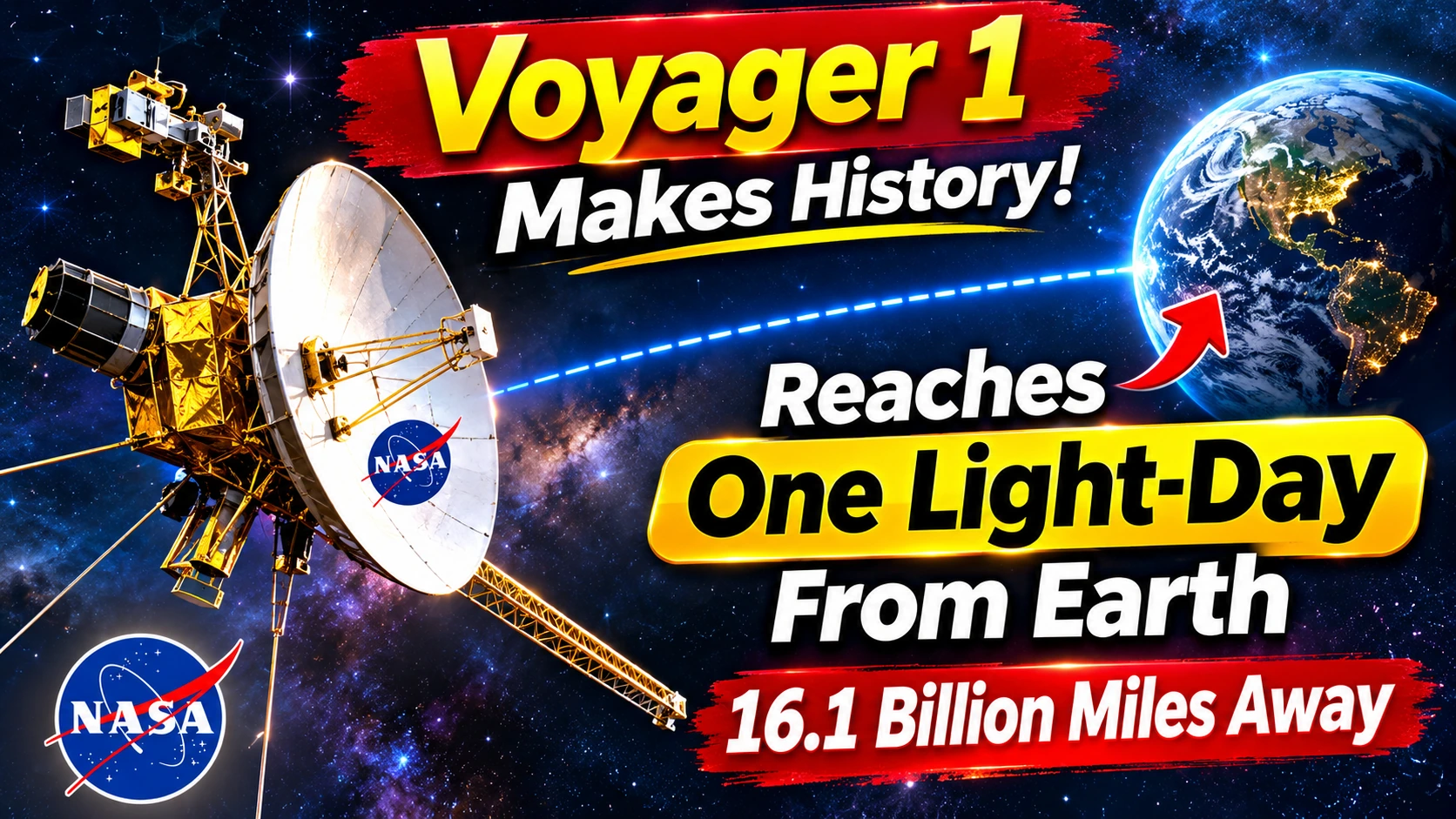
NASA Voyager 1 Reaches One Light-Day: Humanity’s most distant spacecraft has achieved another extraordinary milestone. On November 18, 2026, NASA’s Voyager 1 officially reached a distance of one light-day from Earth, becoming the first human-made object to travel so far into space.
The historic achievement occurred at 5:16 a.m. Eastern Standard Time, more than 49 years after the spacecraft launched in 1977.
Voyager 1 was approximately 16.1 billion miles (25.9 billion kilometers) from Earth when it crossed the milestone. At that distance, even a radio signal traveling at the speed of light requires an entire day to reach the spacecraft.
NASA confirmed the achievement on November 19, highlighting both the mission’s remarkable longevity and the technical challenges of communicating across interstellar space.
🌟 NASA Voyager 1 Historic Milestone: Key Highlights
- 🚀 Historic date: November 18, 2026, at 5:16 a.m. EST.
- 🌌 Distance from Earth: Approximately 16.1 billion miles or 25.9 billion kilometers.
- 📡 Communication delay: 24 hours each way, or approximately 48 hours for a round trip.
- 🛰️ Launch date: September 5, 1977.
- ⚡ Spacecraft speed: Approximately 38,000 mph (61,155 km/h).
- 🔧 Mission status: A carrier signal remains detectable, although science and engineering data transmission is experiencing difficulties.
Voyager 1: One Light-Day From Earth
How long does light take to travel across space?
Source: NASA, November 2026. Light-travel times are approximate except the defined one-light-day milestone. The chart uses a linear 24-hour scale. Small values may be barely visible. This is historical mission information, not a live spacecraft tracker.
🚀 Voyager 1 Becomes the First Spacecraft to Reach One Light-Day
NASA’s Voyager 1 has traveled farther from Earth than any other human-made object.
The spacecraft crossed the one-light-day threshold at 2:16 a.m. Pacific Standard Time on November 18, 2026.
Engineers at NASA’s Jet Propulsion Laboratory in Southern California confirmed the milestone using trajectory calculations and the spacecraft’s radio carrier signal.
The team received the signal approximately 24 hours after the spacecraft reached the historic distance.
The achievement demonstrates the extraordinary endurance of a mission originally designed to investigate the outer planets.
Nearly half a century later, Voyager 1 continues its journey through interstellar space, providing an unprecedented opportunity to study the environment beyond the Sun’s protective influence.
🌌 What Does One Light-Day From Earth Actually Mean?
A light-day is a measurement of distance rather than time.
It represents how far light travels through a vacuum in 24 hours.
Light moves at approximately 186,000 miles per second, making it the fastest known means of transmitting information through space.
Over an entire day, that speed corresponds to approximately 16.1 billion miles.
To understand this enormous distance, consider how quickly light travels between familiar destinations.
Light takes about 1.3 seconds to travel from Earth to the Moon.
Sunlight reaches Earth in approximately eight minutes and 20 seconds.
A light signal takes roughly four hours to reach Neptune, depending on planetary positions.
By comparison, a signal traveling between Earth and Voyager 1 now requires approximately 24 hours.
This means that a command sent from Earth cannot reach the spacecraft immediately, and engineers must wait another day for a possible response.
📡 NASA Faces a 48-Hour Communication Challenge
One of the most remarkable aspects of the Voyager mission is its communication system.
NASA uses the Deep Space Network, a global system of powerful radio antennas, to maintain contact with distant spacecraft.
The network operates facilities at three locations around the world, allowing communication as Earth rotates.
However, Voyager 1’s enormous distance creates unavoidable delays.
A command transmitted from Earth requires approximately 24 hours to arrive.
If the spacecraft responds immediately, its reply takes another 24 hours to return.
Therefore, even a simple command-and-response exchange now requires roughly two days.
This makes troubleshooting significantly more difficult than working with spacecraft closer to Earth.
⚠️ Voyager 1 Experiences a New Data Transmission Problem
NASA also revealed that the mission team had not received science and engineering data from Voyager 1 since November 14, 2026.
However, the spacecraft continued transmitting a radio carrier signal.
This distinction is important because the detectable signal indicates that a radio transmission remains present, even though the expected data has not been successfully received.
Engineers are investigating the problem while using the signal and spacecraft trajectory calculations to monitor the mission.
The communication difficulty does not invalidate the historic one-light-day achievement.
🪐 Voyager 1’s Incredible Journey Since 1977
Voyager 1 launched on September 5, 1977, during an exceptional period for planetary exploration.
NASA designed the Voyager mission to take advantage of a rare alignment of the outer planets.
This arrangement allowed spacecraft to use planetary gravity assists to travel between distant worlds more efficiently.
Voyager 1 explored Jupiter and Saturn, returning detailed observations that transformed scientific understanding of these giant planets and their moons.
Its twin spacecraft, Voyager 2, followed a different route and continued onward to Uranus and Neptune.
Together, the Voyager missions provided groundbreaking information about planetary atmospheres, magnetic fields, rings, and natural satellites.
Although their original planetary exploration objectives ended decades ago, both spacecraft continued operating as interstellar explorers.
🌠 Voyager 1 Entered Interstellar Space in 2012
In 2012, Voyager 1 became the first human-made spacecraft to cross the heliopause and enter interstellar space.
The heliopause marks the outer boundary of the heliosphere, a vast region influenced by particles and magnetic fields originating from the Sun.
Crossing this boundary allowed Voyager 1 to investigate an environment that no spacecraft had directly explored before.
Voyager 2 followed in 2018.
Both probes continue helping scientists understand the interaction between the solar wind and the surrounding interstellar environment.
An important scientific question concerns how far the Sun’s influence extends beyond the heliopause.
Although Voyager 1 has entered interstellar space, it has not left the Milky Way galaxy or traveled beyond the entire solar system under definitions that include the distant Oort Cloud.
⚡ How Is Voyager 1 Still Operating After 49 Years?
Voyager 1 relies on a radioisotope thermoelectric generator, which converts heat produced by radioactive decay into electrical energy.
Unlike solar-powered spacecraft, Voyager does not depend on sunlight for electricity.
This is essential because sunlight becomes extremely weak at such enormous distances.
However, the spacecraft’s power supply gradually declines.
According to NASA, each Voyager probe loses approximately four watts of available power annually.
Engineers have therefore introduced energy-saving measures to extend the mission.
During 2026, the team switched off three devices on Voyager 1 and replaced their functions with lower-power alternatives.
These adjustments help conserve the remaining electricity while preserving important scientific capabilities.
NASA expects the latest power-saving measures to support the current science instrument configurations until at least the spacecraft’s 50th launch anniversaries in 2027.
💿 Voyager 1 Carries Humanity’s Golden Record
Beyond its scientific instruments, Voyager 1 carries a remarkable message from Earth.
The Voyager Golden Record is a gold-plated copper phonograph record containing selected sounds, images, music, and greetings representing life on our planet.
The record was designed as a symbolic message for any advanced civilization that might encounter the spacecraft in the distant future.
Its contents reflect humanity’s desire to communicate beyond Earth.
Even when Voyager 1 eventually loses the ability to communicate with NASA, the spacecraft will continue traveling through space.
The Golden Record may therefore remain a lasting reminder of the civilization that created and launched the probe.
🔮 What Happens Next for Voyager 1?
Voyager 1 will continue moving through interstellar space as long as its trajectory carries it outward.
NASA engineers will focus on maintaining communications, investigating the current data transmission problem, and managing the spacecraft’s declining electrical power.
The mission’s approaching 50th anniversary in 2027 represents another important milestone.
Although its remaining operational lifetime is uncertain, Voyager 1 has already exceeded its original mission expectations by decades.
Its scientific observations continue to influence research into the heliosphere, cosmic radiation, and the interstellar environment.
❓ Frequently Asked Questions About Voyager 1
1. How far is Voyager 1 from Earth in November 2026?
Voyager 1 reached approximately 16.1 billion miles, or 25.9 billion kilometers, from Earth on November 18, 2026. Its distance continues to change as it travels through space.
2. What does one light-day mean?
One light-day is the distance light travels in 24 hours, approximately 16.1 billion miles or 25.9 billion kilometers.
3. How long does a signal take to reach Voyager 1?
At the November 18 milestone, a radio signal required approximately 24 hours to travel one way between Earth and Voyager 1.
4. Is Voyager 1 still working in 2026?
Voyager 1 continued transmitting a carrier signal in November 2026, but NASA reported that science and engineering data had not been received since November 14. Engineers were investigating the issue.
5. When was Voyager 1 launched?
NASA launched Voyager 1 on September 5, 1977, to explore Jupiter and Saturn before its extended journey into interstellar space.
6. Has Voyager 1 left the solar system?
Voyager 1 crossed the heliopause in 2012 and entered interstellar space. However, it has not traveled beyond the distant Oort Cloud, which is often considered part of the broader solar system.
🏁 Conclusion: A Historic Achievement for Humanity
NASA’s Voyager 1 reaching one light-day from Earth marks an extraordinary chapter in the history of space exploration.
Launched in 1977, the spacecraft has traveled more than 16 billion miles, explored the outer planets, entered interstellar space, and continued operating far beyond its original mission.
Despite aging equipment, declining power, and enormous communication delays, Voyager 1 remains one of humanity’s most remarkable engineering achievements.
Its journey demonstrates how scientific curiosity, careful engineering, and decades of dedication can push exploration beyond previously imaginable limits.
Nearly 50 years after leaving Earth, Voyager 1 continues carrying humanity’s curiosity into the darkness between the stars. 🌌