

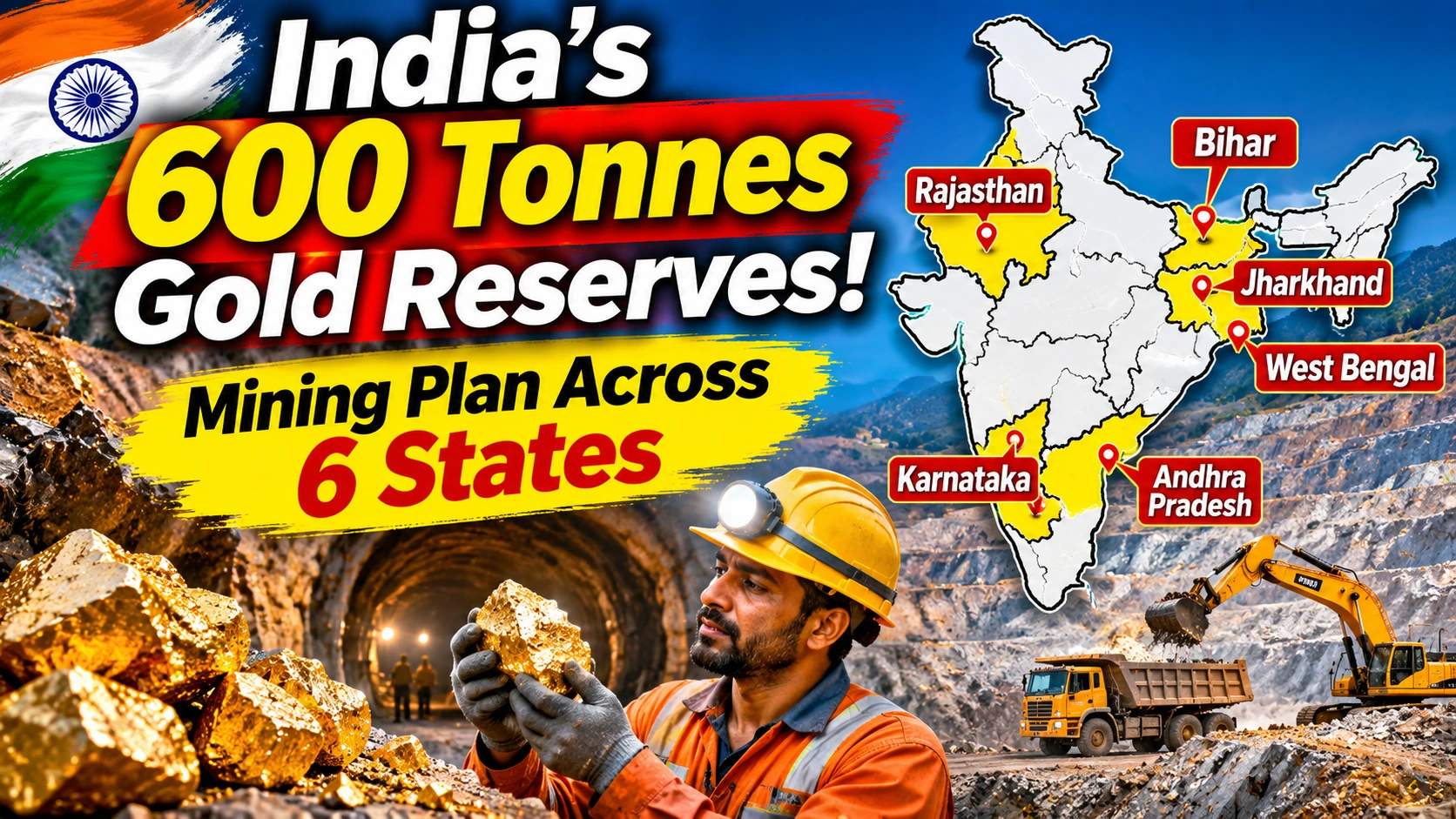
India Gold Reserves 2026: India is preparing a major policy initiative to unlock its vast underground gold resources, estimated at approximately 600–607 tonnes of gold metal. With substantial deposits identified across Bihar, Rajasthan, Karnataka, West Bengal, Andhra Pradesh, and Jharkhand, the government is exploring ways to increase domestic gold mining and reduce dependence on expensive imports.
NITI Aayog, the central government’s policy think tank, is reportedly developing a comprehensive blueprint to attract investment, improve exploration, and simplify mining regulations.
The proposal comes as India continues to import large quantities of gold despite possessing significant geological resources.
According to industry reporting, India imported more than 800 tonnes of gold during the 2025–26 financial year, with imports valued at approximately $71.98 billion.
The proposed reforms could create new opportunities for mining companies while supporting India’s long-term goal of strengthening domestic mineral production.
However, the estimated underground gold resources should not be confused with immediately recoverable gold or the bullion reserves held by the Reserve Bank of India.
Here is everything you need to know about India’s gold reserves in 2026, the six leading states, NITI Aayog’s proposed mining policy, and the possible impact on the economy.
🇮🇳 India Plans to Unlock 600 Tonnes of Underground Gold
India has substantial geological gold resources, but commercial mining has remained relatively limited compared with the country’s demand for the precious metal.
Estimates indicate that India possesses approximately 501–518 million tonnes of primary gold-bearing ore, containing roughly 600–607 tonnes of gold metal.
These figures represent estimated mineral resources, not 600 tonnes of gold that can immediately be extracted profitably.
The actual quantity recoverable through mining depends on geological conditions, ore quality, extraction technology, environmental approvals, and project economics.
NITI Aayog’s proposed initiative aims to address obstacles that have prevented these resources from being developed on a larger scale.
The plan could include financial incentives, improved geological surveys, changes to mining regulations, and greater cooperation between central and state governments.
If implemented effectively, the reforms could encourage more companies to invest in gold exploration and production.
🪙 India Gold Resources 2026: State-Wise Share
Six leading states and their approximate shares of India’s reported primary gold resources.
Note: Percentages are rounded estimates. Bars use a 50% scale for readability. Geological resources are not equivalent to economically recoverable mining reserves.
🏆 Which Indian States Have the Largest Gold Resources?
Six states account for the overwhelming majority of India’s estimated primary gold resources.
Bihar leads the list, followed by Rajasthan and Karnataka.
🥇 1. Bihar — Approximately 44–45%
Bihar holds the largest reported share of India’s primary gold resources.
The state accounts for approximately 44–45% of the national estimate.
However, a large proportion of Bihar’s identified resources remains at an early geological assessment stage.
This means further exploration is necessary before commercially viable mining projects can be established.
🥈 2. Rajasthan — Approximately 25%
Rajasthan ranks second, accounting for roughly one-quarter of the country’s estimated gold resources.
The state already has a significant mining industry and experience in mineral exploration.
Improved geological information and investment policies could support further assessment of its gold-bearing areas.
🥉 3. Karnataka — Approximately 21%
Karnataka accounts for approximately 21% of India’s estimated gold resources.
The state has a long history of gold mining, including the well-known Kolar Gold Fields and operations associated with Hutti.
Its mining experience could be relevant to future gold exploration and development.
🌟 4. West Bengal — Approximately 3%
West Bengal represents around 3% of the reported national gold resource estimate.
Further exploration would be necessary to determine the commercial potential of identified deposits.
🌟 5. Andhra Pradesh — Approximately 3%
Andhra Pradesh also accounts for approximately 3% of the reported resources.
Future mining opportunities will depend on detailed geological surveys, project feasibility, and regulatory approvals.
🌟 6. Jharkhand — Approximately 2%
Jharkhand contributes roughly 2% of India’s estimated gold resources.
The state is already an important mineral-producing region, but gold development would require project-specific technical and economic assessments.
Important: These percentages are rounded resource estimates and should not be interpreted as precise shares of economically recoverable gold. The approximate figures may not total exactly 100%.
📊 India Gold Resources: Six-State Comparison
Bihar, Rajasthan, and Karnataka together account for approximately 90% of the reported resource distribution.
This concentration suggests that future exploration initiatives could place considerable emphasis on these three states.
However, a state’s share of geological resources does not automatically determine how much gold it can produce.
Actual mining output depends on the quality of deposits, infrastructure, technology, environmental requirements, and commercial viability.
The proposed national mining framework is intended to improve the conditions under which these resources can be evaluated and developed.
🏛️ NITI Aayog’s New Gold Mining Policy: What Could Change?
NITI Aayog is reportedly preparing a policy blueprint to encourage investment in India’s gold mining industry.
The proposal is expected to focus on several important areas.
Financial incentives: Fiscal support could help improve the commercial attractiveness of exploration and mining projects.
Long-term mining rights: Greater certainty over mining rights could encourage companies to invest in projects requiring substantial upfront expenditure.
Better geological information: Improved surveys and internationally accepted reporting standards could help investors evaluate deposits more accurately.
Mining auction reforms: Changes to auction procedures and bidder assessment could encourage technically qualified companies to participate.
Faster regulatory coordination: Cooperation between central and state governments could help streamline approvals and reduce unnecessary delays.
The policy discussion follows consideration of recommendations prepared by the Pahle India Foundation with support from the World Gold Council.
These measures remain proposals under consideration, rather than a fully implemented national gold mining reform package.
💰 Why Does India Want to Reduce Gold Imports?
India is one of the world’s largest gold-consuming markets.
Gold plays an important role in jewellery purchases, weddings, festivals, household savings, and investment demand.
However, domestic production supplies only a small portion of the country’s requirements.
As a result, India depends heavily on imported gold.
During the 2025–26 financial year, the country’s gold imports exceeded 800 tonnes and were valued at approximately $71.98 billion.
Large gold imports can increase demand for foreign currency and contribute to India’s merchandise trade deficit.
Depending on broader economic conditions, this can also influence the current account deficit and pressure on the rupee.
Increasing domestic gold production could gradually replace some imported supplies.
However, the impact would depend on the scale, cost, and timing of actual mining output.
📉 India Gold Imports Fall Nearly 40% in April–October 2026
Recent import data also shows a notable decline in India’s gold import bill.
During April–October 2026, the value of gold imports reportedly fell by approximately 39.9% compared with the corresponding period a year earlier.
The import value declined from around $41.24 billion to $24.78 billion.
The reported reduction was associated with changing international gold prices.
Importantly, a decline in the value of gold imports does not necessarily mean that the physical quantity imported declined by the same percentage.
Gold import expenditure depends on both international prices and the volume purchased.
Despite the recent decline, India’s dependence on foreign gold remains substantial.
This is one reason policymakers are considering ways to strengthen domestic mining.
⛏️ Why Has India Not Fully Developed Its Gold Resources?
Several challenges have limited large-scale gold exploration and mining in India.
One major obstacle is the availability of reliable geological information.
Mining companies require detailed data to estimate deposit quality, potential extraction costs, and expected returns.
Without sufficient information, investors may hesitate to commit significant capital.
Another problem involves lengthy project development timelines.
Mining operations often require multiple approvals, environmental assessments, land arrangements, infrastructure investment, and technical studies.
Auction procedures and uncertainty over commercial viability can create additional difficulties.
Gold deposits may also contain relatively small quantities of metal within large volumes of rock.
Extracting that metal requires processing facilities, energy, water, equipment, and skilled workers.
Therefore, identifying gold underground is only the beginning of a much longer development process.
📈 Will India’s Gold Mining Plans Reduce Gold Prices?
The possibility of expanding domestic gold production may attract attention from jewellery buyers and investors.
However, the proposed mining reforms do not guarantee that gold prices in India will fall.
Indian gold prices are influenced by international bullion markets, currency movements, import duties, taxes, and domestic demand.
Even if mining production increases, the additional supply may take years to become commercially significant.
India’s estimated geological resources are also spread across different deposits, and not all may be economically recoverable.
Greater domestic production could potentially reduce import dependence over time, but it would not necessarily cause an immediate decline in retail gold prices.
Consumers should therefore avoid interpreting the policy proposal as a signal that jewellery prices are about to fall.
🌱 Environmental and Economic Challenges Ahead
Expanding gold mining could create opportunities for employment, infrastructure development, and investment in mineral-producing regions.
However, mining projects also require careful environmental and social assessment.
Potential concerns include land use, water consumption, waste management, and the effects of mining activity on surrounding communities.
Project developers must also assess whether deposits can be mined economically under prevailing market conditions.
A sustainable policy would need to balance mineral production with environmental safeguards and community interests.
Clear reporting standards, transparent approvals, and responsible mining practices could help improve investor confidence while protecting local interests.
❓ India Gold Reserves 2026: Frequently Asked Questions
1. How much underground gold does India have in 2026?
India is estimated to possess approximately 600–607 tonnes of primary gold metal resources within its identified gold-bearing ore deposits. This is a geological resource estimate, not the amount of immediately mineable gold.
2. Which Indian state has the largest gold resources?
Bihar has the largest reported share, accounting for approximately 44–45% of India’s estimated primary gold resources.
3. Which six states are important for India’s gold mining plans?
The six leading states are Bihar, Rajasthan, Karnataka, West Bengal, Andhra Pradesh, and Jharkhand.
4. What is NITI Aayog planning for gold mining?
NITI Aayog is considering a policy framework involving financial incentives, better geological surveys, mining auction reforms, long-term mining rights, and improved regulatory coordination.
5. Will India’s 600 tonnes of gold resources reduce gold prices?
Not necessarily. The resources require exploration and commercial development, while domestic gold prices continue to depend heavily on international prices, exchange rates, taxes, and demand.
🏁 Conclusion
India’s estimated 600–607 tonnes of underground gold resources represent a significant long-term opportunity for the country’s mining industry.
With Bihar, Rajasthan, and Karnataka accounting for the largest reported shares, the proposed NITI Aayog policy could help attract investment and improve exploration across mineral-rich regions.
The initiative is particularly important because India continues to spend billions of dollars importing gold every year.
However, turning geological resources into commercially viable production will require detailed exploration, investment, regulatory coordination, and responsible mining practices.
If these challenges can be addressed, India’s gold mining reforms could gradually strengthen domestic supply, reduce some import dependence, and support the country’s broader mineral development strategy.