

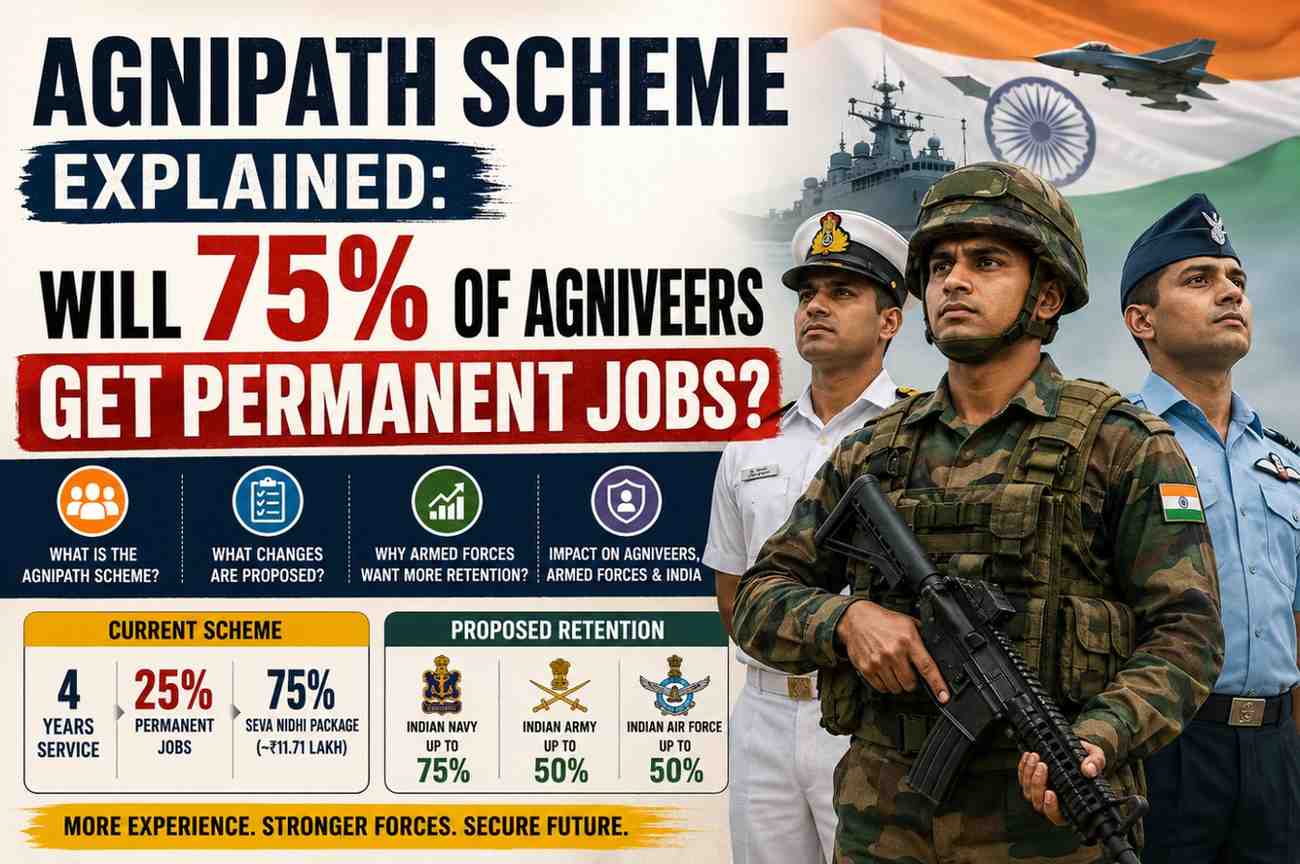
Agnipath Scheme Explained: The Agnipath Scheme, launched in 2022, could soon witness its biggest overhaul since its introduction.
At present, only 25% of Agniveers completing their four-year service are selected for permanent employment in the armed forces. However, the Indian Army, Indian Navy and Indian Air Force have jointly proposed increasing this limit because they believe retaining more trained personnel is now essential.
So, why do the armed forces want this change? Could 50% to 75% of Agniveers soon get permanent jobs?
Here’s everything you need to know.
📌 What Is the Agnipath Scheme?
The Agnipath Scheme was introduced by the Government of India in June 2022 to recruit young soldiers into the three armed forces.
Under the scheme:
✅ Age: 17.5–21 years (relaxations announced during initial recruitment)
✅ Service period: 4 years
✅ Recruits are called Agniveers
After completing four years:
- 🎖️ 25% are selected for permanent service based on merit, medical fitness and organisational requirements.
- 🪖 These selected candidates continue serving for at least 15 more years.
- 💰 Salary ranges between ₹40,000–₹60,000 per month, depending on service and experience.
- 💵 The remaining 75% receive the Seva Nidhi package worth around ₹11.71 lakh, which includes contributions from both the government and the Agniveer.
🎯 Why Was the Agnipath Scheme Introduced?
The government launched the scheme with three major objectives:
✅ Reduce the average age of the armed forces
✅ Lower the long-term pension burden
✅ Save funds for modern weapons, technology and military infrastructure
🚨 What Changes Are Being Proposed?
The three armed forces now want to increase the permanent absorption limit beyond the existing 25%.
Proposed Retention of Agniveers
| Armed Force | Proposed Permanent Retention |
|---|---|
| ⚓ Indian Navy | Up to 75% |
| 🪖 Indian Army | Up to 50% |
| ✈️ Indian Air Force | Up to 50% |
The proposal is currently under discussion within the Ministry of Defence and has not yet been approved.
🤔 Why Do the Armed Forces Want More Agniveers?
Several operational reasons have prompted this proposal.
1️⃣ Four Years Is Too Short for Technical Roles
Modern military equipment requires highly specialised training.
For many naval and technical positions, soldiers take three years or more just to become fully operational.
If most trained personnel leave after only four years, the armed forces lose experienced manpower just when those soldiers become most valuable.
2️⃣ Modern Warfare Requires Long-Term Training
India’s armed forces are rapidly adopting:
- Advanced missiles
- Drones
- AI-enabled systems
- Electronic warfare
- Modern warships
- Sophisticated fighter aircraft
Training personnel on these complex systems takes years.
Retaining experienced Agniveers would reduce the need to repeatedly train new recruits.
3️⃣ Lessons Learned from Operation Sindoor
According to the armed forces, Operation Sindoor demonstrated that Agniveers performed well during operations.
However, commanders also realised that battlefield experience cannot be replaced by classroom training.
Experienced soldiers:
- React faster
- Handle emergencies better
- Make better tactical decisions
- Operate advanced equipment more effectively
This has strengthened the case for increasing permanent retention.
4️⃣ Addressing Manpower Shortages
The armed forces face a significant shortage of personnel as thousands retire every year.
Reports indicate the services are working to bridge a shortage of around 1.8 lakh personnel over the next few years.
Retaining more trained Agniveers could help fill this gap.
❓What If the Government Doesn’t Increase the 25% Limit?
Even if the proposal is not approved, the Army has other options.
One possibility is deploying more experienced Agniveers in specialised formations such as elite battalions while maintaining the overall 25% retention policy.
This would ensure critical operational units continue benefiting from experienced personnel without changing the existing rules.
🛡️ Other Major Changes Under Consideration
Apart from increasing permanent recruitment, two welfare proposals are reportedly being discussed.
❤️ Lifetime Financial Support for Families of Martyred Agniveers
The government is considering providing long-term financial assistance to families of Agniveers who are martyred while serving the nation.
🏥 Lifetime Free Medical Treatment
Agniveers who suffer disabilities during service may receive free lifelong medical treatment.
These proposals aim to address concerns raised about the welfare of Agniveers and their families.
📊 How Could These Changes Impact India?
✅ 1. More Experienced Armed Forces
Retaining skilled soldiers means greater operational readiness and improved combat effectiveness.
✅ 2. Better Career Security
If 50–75% of Agniveers receive permanent jobs, thousands of young recruits would enjoy greater job stability and long-term career prospects.
✅ 3. Higher Government Pension Costs
One of the original goals of the Agnipath Scheme was to reduce pension expenditure.
Increasing permanent recruitment would naturally increase future pension liabilities.
✅ 4. Fewer Vacancies for Fresh Recruits
Higher retention could reduce opportunities for new applicants.
However, the Army is also planning to recruit around 90,000 personnel next year, which may offset some of this impact.
📌 Key Takeaways
⭐ The current Agnipath Scheme allows 25% permanent recruitment after four years.
⭐ The Indian Navy wants up to 75% retention, while the Army and Air Force seek up to 50%.
⭐ The proposal is still under consideration by the Ministry of Defence.
⭐ The changes aim to improve military readiness, retain skilled personnel and strengthen national security.
⭐ Welfare measures for Agniveers and their families are also under discussion.
❓Frequently Asked Questions (FAQs)
Will 75% of Agniveers get permanent jobs?
No. As of now, only 25% are eligible for permanent recruitment. The proposal to increase this is still under discussion.
Why does the Navy want 75% retention?
The Navy believes technical roles require years of training, making longer retention more efficient.
Is the proposal approved?
No. The Ministry of Defence is yet to take a final decision.
Will Agniveers receive pensions?
Only those absorbed into permanent service become eligible for pension benefits under the applicable service rules. Those who complete only the four-year tenure receive the Seva Nidhi package instead.
What is the Seva Nidhi package?
Eligible Agniveers leaving after four years receive a tax-free lump sum of around ₹11.71 lakh, subject to the terms of the scheme.
Keypoints: Agniveer, 75% permanent jobs, Agnipath latest news, Army recruitment, Navy Agniveer, Air Force Agniveer, Defence Ministry