

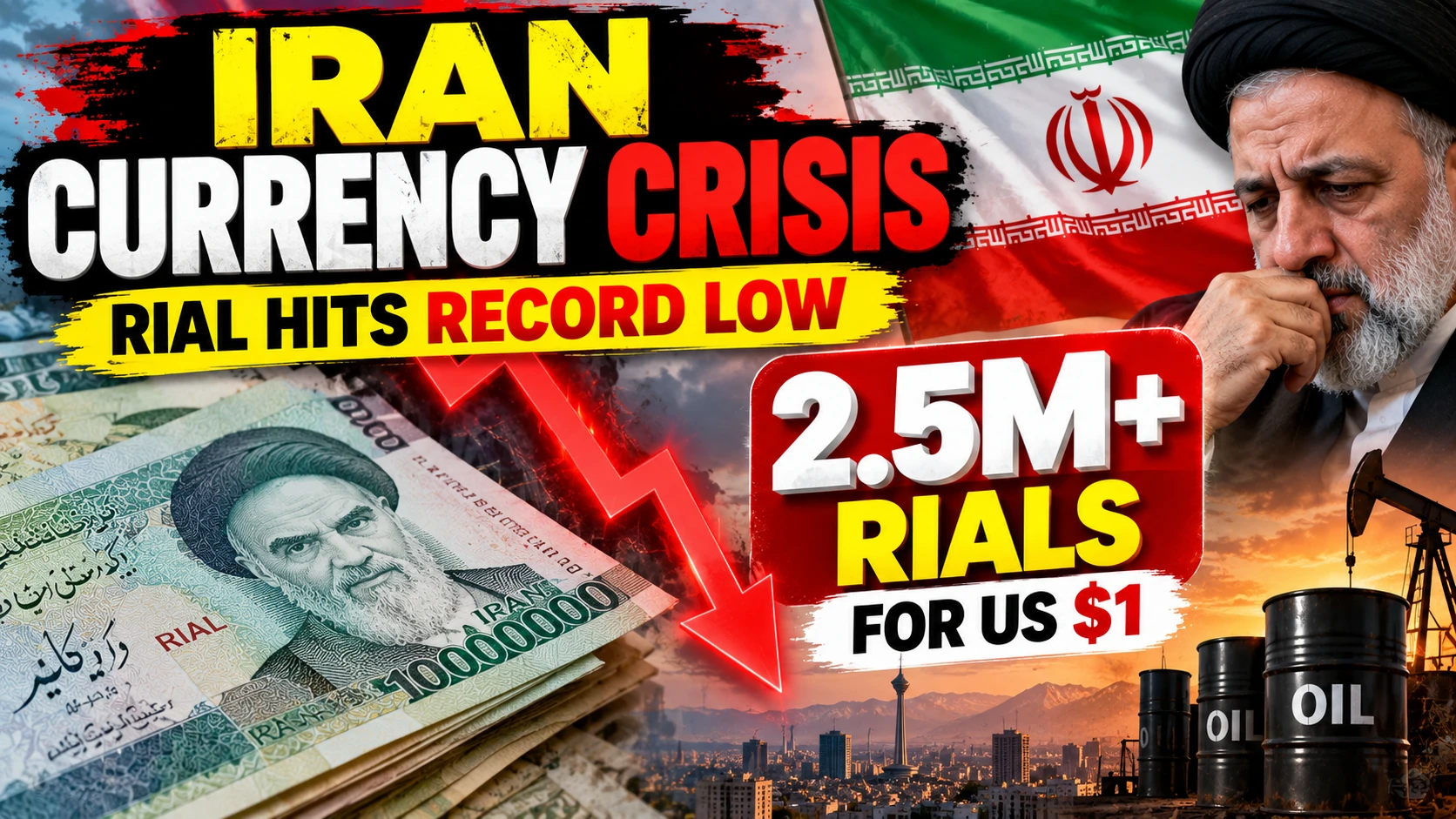
Iranian rial record low: The Iranian rial has fallen to a record low, adding another layer of pressure to an economy already struggling with high inflation, sanctions and disruption caused by the continuing regional conflict. 📉
On September 29, 2026, the Associated Press reported that traders in Tehran were exchanging more than 2.5 million Iranian rials for one U.S. dollar on the open market.
The latest decline is significant because the rial’s previous record low, approximately 2.2 million per dollar, had been reached only on September 2.
The currency’s weakness affects far more than foreign-exchange traders. A weaker rial can make imported products more expensive, reduce household purchasing power and add to inflationary pressure for ordinary Iranians.
So why is Iran’s currency falling so sharply?
📊 Iran Currency Crisis: Quick Facts
Iran Currency Crisis: Quick Facts
Iranian Rial, Inflation & Economy — 2026
⚠️ What’s Putting Pressure on the Rial?
💱 What Happened to the Iranian Rial?
The Iranian currency has been under pressure for years, but the deterioration accelerated substantially during 2026.
According to recent reporting, the rial repeatedly reached new lows following the outbreak of the current conflict in February.
By September 29, traders in Tehran’s open market were exchanging more than 2.5 million rials for one U.S. dollar.
To understand why that matters, consider what happens when a currency weakens.
If an imported product costs $100, an importer needs substantially more rials to buy the same product when the rial falls against the dollar.
Those additional costs can eventually reach consumers through higher retail prices.
🔥 Why Is the Iranian Rial Falling?
There is no single explanation for the rial’s weakness. Several economic and geopolitical pressures are interacting simultaneously.
1. US Sanctions and Economic Pressure
International sanctions, particularly U.S. sanctions, have constrained Iran’s access to parts of the international financial system for years.
Recent U.S. measures have increased the pressure.
Reuters reported in September that Iran had fewer remaining channels through which it could secure foreign currency or purchase goods as Washington intensified its economic campaign.
Foreign currency is especially important for a country that needs to finance imports.
When dollars and other foreign currencies become more difficult to obtain, demand can rise relative to supply, putting additional pressure on the domestic currency.
Iran Currency Crisis 2026
Key economic facts at a glance
2. Oil Export Disruptions 🛢️
Oil has historically been one of Iran’s most important sources of foreign-currency earnings.
Reuters reported on September 1 that Iran had gone roughly seven weeks without meaningful crude shipments through the Strait of Hormuz amid a U.S. naval blockade.
Reduced oil-export earnings can limit the supply of foreign currency flowing into the economy.
That makes oil-export disruption especially important when examining the rial’s decline.
3. Extremely High Inflation
Iran is also dealing with severe inflation.
The International Monetary Fund currently projects a 68.9% increase in consumer prices for 2026.
High inflation and currency depreciation can reinforce one another.
When domestic prices rise rapidly, people may become less willing to hold savings in the local currency and seek alternatives such as foreign currencies or other assets.
At the same time, a falling currency raises the domestic cost of imported goods.
This can create another round of inflationary pressure.
🛒 What Does a Falling Rial Mean for Ordinary Iranians?
The consequences of currency depreciation are most visible in everyday purchasing power.
Iran imports various consumer goods, industrial components, medicines and raw materials. When importers need more rials to obtain dollars, euros or other currencies, imported products become more expensive in local-currency terms.
Food prices have been a particularly serious concern.
Recent reports citing official Iranian data have indicated extremely sharp year-on-year increases in food prices.
For households whose incomes fail to rise as quickly as prices, the practical result is declining purchasing power.
The same salary simply buys fewer goods and services.
📉 Is Iran’s Economy Shrinking?
Current IMF projections point to economic contraction in 2026.
The IMF’s Iran country data currently projects real GDP to decline by 5.4% in 2026.
That means the inflation problem is occurring alongside an expected contraction in economic output—a particularly difficult combination for households and businesses.
The IMF has also highlighted broader regional economic damage from the 2026 conflict, including disruption to trade, energy production and transportation.
🏦 What Is Iran’s Central Bank Doing?
Iranian officials have rejected suggestions that the country has run out of foreign currency.
On September 1, Central Bank Governor Abdolnaser Hemmati said Iran had sufficient foreign-currency resources despite U.S. sanctions.
He also said the central bank was prepared to inject as much as $2 billion into the foreign-exchange market to address volatility.
Such intervention can potentially support a currency by increasing the availability of foreign exchange.
However, longer-term currency stability generally depends on a wider set of factors, including inflation expectations, trade flows, fiscal and monetary conditions, foreign-exchange earnings and geopolitical developments.
🌍 Why Does Iran’s Currency Crisis Matter Globally?
Iran’s economic problems are not isolated from the rest of the world.
The Strait of Hormuz is one of the world’s most important energy routes.
The IMF has estimated that roughly one-fifth of global oil supply normally passes through the strait, along with a substantial share of global liquefied-natural-gas trade.
Consequently, disruption around Iran and the Strait of Hormuz can affect energy prices, transportation costs and inflation well beyond Iran.
That is why developments involving Iran’s economy, oil exports and currency are closely watched by international markets.
🔮 What Happens Next?
The rial’s future will depend on several factors rather than one event.
These include developments in the conflict, Iran’s ability to export oil and earn foreign currency, inflation, monetary policy, sanctions and any diplomatic negotiations that alter trade or financial restrictions.
Iranian officials have maintained that the economy can withstand the pressure, while U.S. officials argue that their economic measures are significantly constraining Tehran.
For consumers, however, the immediate concern is more practical: what happens to prices, employment and household purchasing power.
❓ Frequently Asked Questions
1. What is the Iranian rial worth against the US dollar?
On September 29, 2026, AP reported an open-market exchange rate in Tehran of more than 2.5 million rials for one U.S. dollar.
2. Why is the Iranian rial falling?
Major pressures include high inflation, international sanctions, restrictions affecting oil exports and foreign-currency earnings, and economic disruption associated with the ongoing conflict.
3. What is Iran’s inflation rate in 2026?
The IMF currently projects consumer-price inflation of 68.9% for 2026.
4. Is Iran’s economy in recession?
The IMF currently projects Iran’s real GDP to contract by 5.4% in 2026.
5. How do US sanctions affect Iran’s currency?
Sanctions can restrict international financial transactions, trade and access to foreign-currency earnings. Reduced availability of dollars and other foreign currencies can contribute to pressure on the rial.
6. Why are Iran’s oil exports important?
Oil exports provide foreign-currency revenue. Disruption to those exports can reduce foreign-exchange inflows, potentially increasing pressure on the rial.
🏁 Conclusion
The Iranian rial’s record low reflects a combination of longstanding structural economic problems and extraordinary pressures in 2026.
The open-market currency has moved beyond 2.5 million rials per U.S. dollar, while the IMF projects 68.9% consumer-price inflation and a 5.4% contraction in real GDP for 2026.
Sanctions, restrictions on oil exports, limited access to foreign currency, high inflation and war-related disruption are all important parts of the picture.
For ordinary Iranians, the most consequential effects are declining purchasing power and rising costs. For the wider global economy, developments around Iran remain important because of the country’s role in energy markets and the strategic importance of the Strait of Hormuz.