

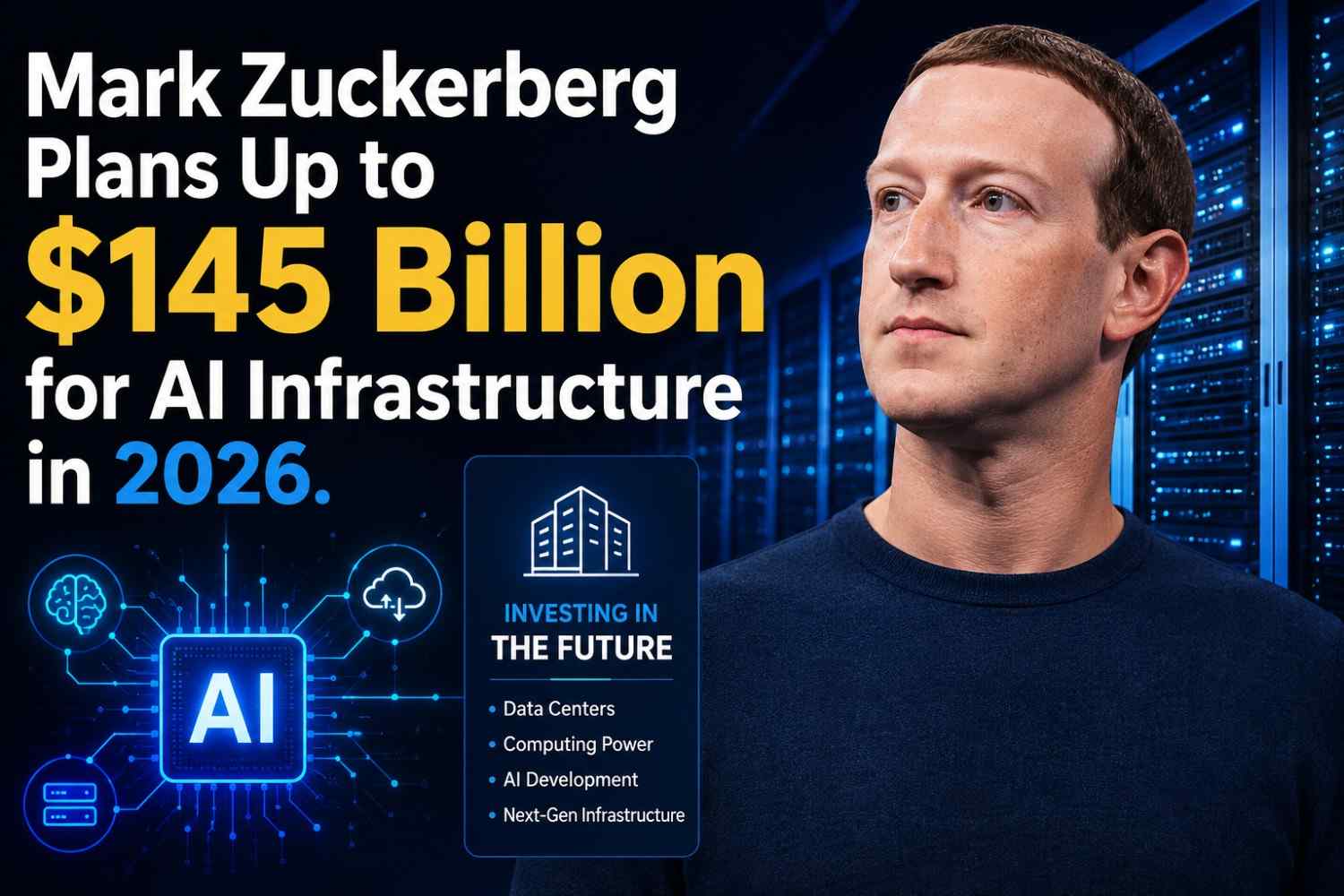
Mark Zuckerberg: Meta Platforms (NASDAQ: META) is making an enormous bet on artificial intelligence, and investors are beginning to feel the financial pressure.
After the market closed on July 29, Meta shares fell 10% following the company’s second-quarter results. Earnings for the quarter ended June 30 came in below expectations, while Meta’s third-quarter revenue outlook was weaker than Wall Street had anticipated.
The decline extends a difficult stretch for the social media giant. Meta’s stock is now trading about 26% below its August 2025 all-time high.
But the bigger story may not be the latest earnings miss. It is how much Meta is willing to spend to build the AI infrastructure it believes will power its next phase of growth.
Meta has raised the lower end of its 2026 capital expenditure forecast to $130 billion, up from $125 billion. The company maintained the upper end of its forecast at a staggering $145 billion.
That puts Meta among the biggest corporate spenders in the global AI infrastructure race.
💰 Meta could spend up to $145 billion on AI infrastructure
Meta’s AI ambitions are coming with a huge price tag.
The company is investing heavily in data centers, computing capacity, research and development, and other infrastructure needed to train and operate increasingly sophisticated AI systems.
For investors, the key question is no longer whether Meta is spending aggressively on AI. It clearly is.
The question is whether those investments will eventually generate enough additional revenue and profit to justify the enormous upfront cost.
Meta believes AI can improve virtually every part of its business, from advertising performance to the user experience across its social platforms.
But the financial impact is already becoming visible.
📉 Meta’s profits are coming under pressure
Meta reported $18.8 billion in operating income during the second quarter, down 8% from the same period a year earlier.
The decline came as costs and expenses jumped 55%.
Research and development was a major contributor, with spending increasing 68% year over year.
That spending reflects the scale of Meta’s push into AI.
For years, Meta benefited from a highly profitable advertising business that generated enormous amounts of cash. Now, the company is redirecting a much larger portion of that financial power toward infrastructure and AI development.
That creates a difficult trade-off for investors.
Meta is spending heavily today in the hope of creating a much larger and more valuable business tomorrow.
💸 Free cash flow has nearly disappeared
Perhaps the clearest sign of the financial impact is Meta’s free cash flow.
Free cash flow, or FCF, is the cash a company has left after paying for its capital expenditures. It is an important measure because it shows how much cash a business can potentially use for acquisitions, debt reduction, dividends, or stock buybacks.
Meta generated $8.5 billion of free cash flow in the second quarter of 2025.
In the latest quarter, that figure fell to just $784 million.
That’s a dramatic decline.
The reason is straightforward: Meta is spending substantially more money on infrastructure while simultaneously increasing investment in AI research and development.
Like other major technology companies, Meta is going through what could be described as an AI infrastructure spending supercycle.
The scale of the investment is so large that the consensus view among analysts cited in the source material is that Meta could post negative free cash flow in both 2026 and 2027.
For a company that has historically generated massive amounts of cash, that would represent a significant change.
🏦 Meta’s balance sheet is changing too
Meta’s increased spending is also showing up on its balance sheet.
Long-term debt reached $83.7 billion, compared with $58.7 billion at the end of the previous year.
At the same time, cash and cash equivalents declined 57%.
Meta also made no share repurchases during the first six months of 2026.
That matters because stock buybacks have historically been an important way for Meta to return capital to shareholders.
The combination of higher spending, rising debt, lower cash holdings, and reduced buybacks gives investors another reason to pay close attention to the company’s AI strategy.
🤖 Meta wants AI to make its core business better
There is, however, another side to the story.
Meta doesn’t necessarily need AI to become a standalone multibillion-dollar business for its investment to pay off.
The technology could create enormous value by making Meta’s existing businesses more efficient and profitable.
AI can potentially improve the recommendations that determine what users see across Meta’s platforms. It can also help advertisers target audiences more effectively and improve the performance of advertising campaigns.
That could ultimately increase the value of Meta’s enormous user base.
Mark Zuckerberg also emphasized this point during Meta’s second-quarter earnings call, saying the company’s AI investments are improving the experience for users, increasing advertiser performance, and helping employees build and launch new products more quickly.
In other words, Meta’s AI strategy is not simply about creating another AI chatbot or model.
It is about using AI throughout the company’s existing ecosystem.
🖥️ Meta could also monetize excess computing capacity
There is another potential source of revenue that investors should watch.
Meta has indicated that it plans to sell excess technical capacity to third-party customers.
Zuckerberg said on the Q2 2026 earnings call that the company has received several offers at a meaningful premium over what Meta paid for the computing capacity.
That could provide Meta with a way to generate revenue from infrastructure that might otherwise remain underutilized.
The opportunity is particularly interesting because demand for AI computing remains strong while high-end computing capacity remains constrained.
If Meta can monetize some of its excess capacity while continuing to use its infrastructure for its own AI ambitions, the company could potentially offset part of the enormous cost of its investment program.
⚠️ The biggest risk: Will AI generate enough returns?
This is ultimately the central issue for Meta shareholders.
Spending up to $145 billion on capital expenditures in 2026 is not inherently positive or negative.
What matters is the return Meta eventually earns on that investment.
If AI significantly improves advertising performance, increases engagement, creates new products, and generates additional revenue from computing infrastructure, today’s spending could look reasonable in hindsight.
But if the financial benefits take much longer to arrive, investors could face years of lower free cash flow and higher costs.
That’s especially important when Meta’s stock is already under pressure.
The company has built an exceptionally profitable business around digital advertising. Investors now have to determine whether Meta can use AI to make that core business even more valuable—or whether the company is simply entering an expensive infrastructure race with uncertain returns.
📊 What investors should watch next
Meta’s next few quarters could provide important clues about whether its AI strategy is beginning to translate into financial results.
Investors should pay particular attention to:
- Capital expenditures: Is Meta’s spending moving toward the upper end of its guidance?
- Free cash flow: How quickly does cash generation recover—or does it remain under pressure?
- Advertising performance: Are AI improvements producing better results for advertisers?
- Revenue growth: Is Meta’s investment translating into stronger sales?
- Operating expenses: Can the company control costs while continuing to invest heavily in AI?
- AI monetization: Can Meta generate meaningful revenue from its computing infrastructure and new AI products?
- Share repurchases: When will Meta have enough excess cash to resume significant buybacks?
These indicators may tell investors more about the success of Meta’s AI strategy than the headline spending number alone.
🧠 The bottom line for Meta investors
Meta is making one of the largest AI infrastructure investments in corporate history, with 2026 capital expenditures potentially reaching $145 billion.
That spending is already putting pressure on profits, free cash flow, the balance sheet, and shareholder returns.
But the investment could also strengthen Meta’s core advertising business and create entirely new opportunities if the company’s AI infrastructure and technology deliver the expected returns.
For investors, the story is therefore bigger than whether Meta stock goes up or down after one earnings report.
The real question is whether Mark Zuckerberg can turn an enormous AI infrastructure bill into an even more valuable Meta business.
At this scale, the answer could have a major impact on Meta’s earnings, cash flow, and stock performance over the next several years.