

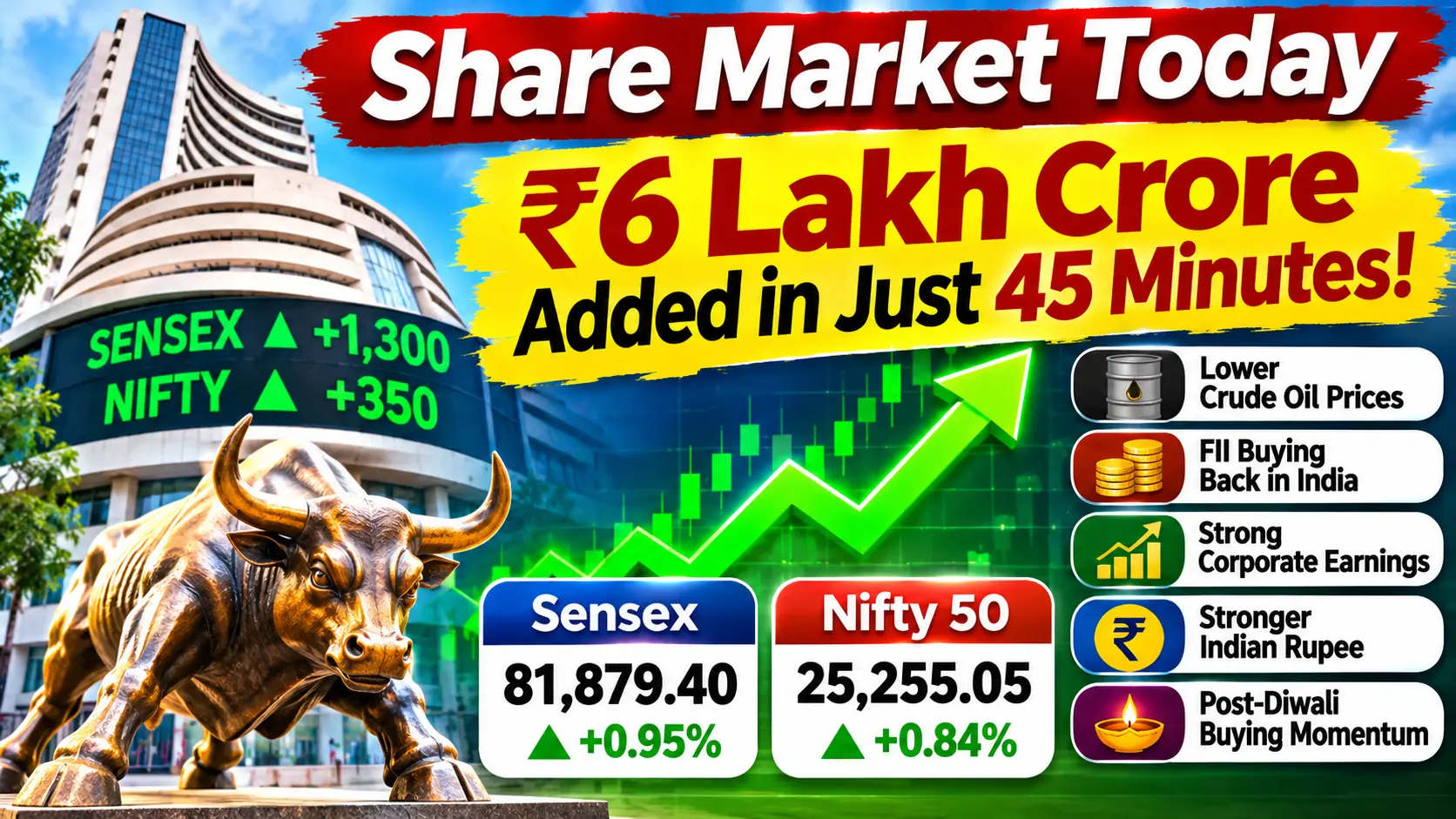
Share Market Today: Indian stock markets witnessed a powerful rally on Wednesday as the BSE Sensex surged more than 1,300 points during morning trading and the Nifty 50 climbed above 25,400. The rally added approximately ₹6 lakh crore to the market capitalisation of BSE-listed companies within just 45 minutes.
Indian investors returned from the Diwali holiday to a strong buying wave on Dalal Street. Benchmark indices opened sharply higher, supported by declining crude oil prices, renewed foreign institutional investor (FII) buying, and encouraging corporate earnings.
By 10 AM, the combined market capitalisation of companies listed on the Bombay Stock Exchange had increased from approximately ₹506.42 lakh crore to ₹512.45 lakh crore.
The remarkable rise immediately attracted attention across India’s financial markets.
However, the rally moderated later in the session. The Sensex eventually closed at 81,879.40, while the Nifty 50 settled at 25,255.05.
So, why did the Indian stock market rise today, and what does this rally mean for investors?
Here are the five major factors driving the market’s recovery.
🚀 Share Market Today: Sensex and Nifty Rally After Diwali
The Indian stock market started Wednesday’s session with strong momentum following Tuesday’s Diwali holiday.
The Sensex jumped more than 1,300 points in early trading, reaching approximately 82,486 by 9:45 AM.
Meanwhile, the Nifty 50 gained more than 350 points and crossed the 25,400 level.
The broader market also participated in the rally, with several mid-cap and small-cap stocks recording gains.
Banking, automobile, and financial services shares attracted significant buying interest.
The positive sentiment reflected improving confidence among investors after months of volatility caused by global economic uncertainty and geopolitical tensions.
Although the market gave back part of its morning gains, both benchmark indices finished the session higher.
📈 Share Market Today: ₹6 Lakh Crore Rally
BSE-listed companies’ market capitalisation during morning trading on November 11, 2026.
| Indicator | Value |
|---|---|
| Opening Market Cap | ₹506.42 Lakh Crore |
| 10 AM Market Cap | ₹512.45 Lakh Crore |
| Market Value Added | ₹6.03 Lakh Crore |
| Sensex Closing | 81,879.40 |
| Nifty 50 Closing | 25,255.05 |
💰 Investors Gain ₹6 Lakh Crore in Just 45 Minutes
One of the biggest highlights of today’s market rally was the sharp increase in the combined market value of BSE-listed companies.
At the beginning of trading, their total market capitalisation stood at approximately ₹5,06,41,936 crore.
By 10 AM, the figure had climbed to approximately ₹5,12,45,010 crore.
This represented an increase of ₹6,03,074 crore, or approximately ₹6.03 lakh crore.
📊 Indian Stock Market Rally: Key Figures
| Market indicator | Reported figure |
|---|---|
| BSE market cap at opening | ₹506.42 lakh crore |
| BSE market cap around 10 AM | ₹512.45 lakh crore |
| Market value added | ₹6.03 lakh crore |
| Sensex early surge | Over 1,300 points |
| Nifty early level | Above 25,400 |
| Sensex closing level | 81,879.40 |
| Nifty 50 closing level | 25,255.05 |
These figures highlight the scale of the morning rally.
However, an increase in market capitalisation does not mean that investors collectively received ₹6 lakh crore in cash.
It represents the increase in the market value of listed shares, based on prevailing stock prices.
Actual profits depend on individual holdings and whether investors sell their shares.
🛢️ 1. Falling Crude Oil Prices Support Indian Markets
One of the most important reasons behind the stock market rally was the recent decline in international crude oil prices.
Brent crude had previously traded above $100 per barrel amid geopolitical uncertainty.
However, prices fell sharply and briefly moved below $90 on Tuesday before recovering toward $92 on Wednesday.
This development is particularly important for India because the country imports a substantial portion of its crude oil requirements.
Higher oil prices increase India’s import bill and can put pressure on inflation, the rupee, and corporate profitability.
Lower crude prices, on the other hand, can reduce transportation and manufacturing expenses.
They may also improve the earnings outlook for oil-sensitive industries.
As a result, investors welcomed the recent correction in crude oil prices.
However, the benefits depend on whether lower prices can be sustained.
🌍 2. Foreign Institutional Investors Return to Dalal Street
Another major factor supporting the Indian stock market was renewed buying by foreign investors.
Foreign institutional investors had previously reduced their exposure to Indian equities during periods of global uncertainty.
But November has witnessed a notable change in sentiment.
According to market data, foreign portfolio investors invested approximately ₹53,739 crore in Indian equities during the first nine days of November.
This followed substantial outflows in September and October.
Foreign investors also reportedly purchased more than ₹7,200 crore worth of Indian shares during Monday’s trading session.
The renewed inflows have supported major benchmark stocks and strengthened confidence in India’s equity market.
Large-cap banking, financial services, automobile, and telecommunications companies have benefited from improving demand.
Continued foreign buying could provide support to the market, although international capital flows can reverse quickly.
📈 3. Strong Quarterly Earnings Improve Investor Confidence
Better-than-expected corporate earnings have also played an important role in the rally.
Several Indian companies reported encouraging financial performance for the July–September 2026 quarter.
Market analysts highlighted strong earnings growth among major businesses, including companies operating in banking, metals, pharmaceuticals, industrial manufacturing, and consumer-related sectors.
Recent estimates indicated that Nifty 50 companies delivered earnings growth of approximately 24% during the quarter.
Improving corporate profitability can help support stock valuations.
When companies demonstrate stronger earnings, investors may become more confident about future business performance.
This can encourage additional investment, particularly after a period of market correction.
However, earnings performance varies between sectors and individual companies.
Investors should therefore examine company-specific financial results rather than assuming every stock will benefit equally.
💵 4. Stronger Indian Rupee Adds to Positive Sentiment
The Indian rupee also contributed to the improved market environment.
On Wednesday, the currency opened approximately 0.2% stronger against the US dollar.
The rupee was quoted near 93.72 per dollar, compared with its previous close of approximately 93.93.
A stronger rupee can help reduce the domestic cost of imported goods, including certain energy and industrial inputs.
It may also ease concerns about inflation and external financial pressures.
For foreign investors, currency stability is another important consideration when evaluating investments in Indian equities.
However, currency movements affect industries differently.
Export-oriented companies may face challenges when the rupee strengthens, while import-dependent businesses may benefit.
🪔 5. Post-Diwali Buying Extends November’s Market Recovery
The market’s strong performance also reflected positive sentiment following the Diwali holiday.
Indian equities had already recorded a substantial recovery during November before Wednesday’s session.
The Sensex and Nifty had gained nearly 9% earlier in the month, supported by foreign fund inflows, improving earnings expectations, and lower oil prices.
The reopening of markets after the holiday encouraged further buying.
Positive momentum in banking and automobile shares helped extend the rally.
By the end of Wednesday’s session, the Nifty 50 had gained approximately 0.84%, while the Sensex advanced around 0.95%.
Both indices reached their highest closing levels since late February 2026.
The broader market also remained positive, indicating that the recovery was not limited to a handful of large companies.
🏦 Which Sectors Performed Well Today?
Banking and automobile stocks were among the major beneficiaries of Wednesday’s trading session.
Banking shares gained approximately 1.8%, while automobile stocks rose around 2.1%.
The small-cap segment advanced approximately 1.6%, and mid-cap stocks gained around 0.8%.
Several prominent companies attracted buying interest during the session, including major banks, automobile manufacturers, and telecommunications businesses.
Positive corporate earnings, improving foreign investor sentiment, and expectations of stronger economic activity contributed to the gains.
However, market performance was not uniform across every sector.
Some companies experienced limited gains or declines despite the broader rally.
⚠️ What Should Stock Market Investors Watch Next?
Although the market recovery has improved investor confidence, several risks remain.
Crude Oil Price Volatility
Any fresh rise in international oil prices could increase inflation concerns and pressure India’s import bill.
Foreign Investor Flows
Continued FII buying may support market sentiment, but a reversal could create volatility.
Global Geopolitical Developments
Changes in Middle East tensions could affect energy prices and international financial markets.
US Economic Data
American inflation figures, interest rate expectations, and bond yields could influence global capital flows.
Corporate Earnings and Valuations
Investors should monitor whether earnings growth can justify current share prices.
A sharp market rally does not eliminate investment risks.
Long-term investors should focus on financial goals, diversification, company fundamentals, and personal risk tolerance.
❓ Share Market Today: Frequently Asked Questions
1. Why is the Indian stock market rising today?
The Indian stock market rallied on November 11, 2026, due to lower crude oil prices, renewed foreign institutional investor buying, encouraging corporate earnings, and positive post-Diwali sentiment.
2. How did investors gain ₹6 lakh crore in one hour?
The combined market capitalisation of BSE-listed companies increased by approximately ₹6.03 lakh crore during the first 45 minutes of trading. This was an increase in share market value, not guaranteed cash profits.
3. How much did the Sensex rise on November 11, 2026?
The Sensex surged more than 1,300 points during early trading before closing at 81,879.40, up approximately 0.95% for the session.
4. What was the Nifty 50 closing price today?
The Nifty 50 closed at 25,255.05 on November 11, 2026, recording a gain of approximately 0.84%.
5. Will the Indian stock market continue rising?
Future market performance will depend on crude oil prices, foreign investment flows, corporate earnings, global economic conditions, and investor sentiment. Continued gains are not guaranteed.
📝 Final Thoughts: Can Dalal Street Maintain Its Momentum?
The Indian stock market rally on November 11, 2026, marked another encouraging session for investors.
A sharp rise in the Sensex and Nifty, combined with approximately ₹6 lakh crore added to BSE market capitalisation during morning trading, demonstrated the strength of renewed buying interest.
Lower crude oil prices, foreign investor inflows, better corporate earnings, and post-Diwali optimism provided important support.
However, investors should remain cautious because stock markets can change direction rapidly.
Monitoring economic indicators, maintaining diversified investments, and avoiding emotional trading decisions remain essential.
Do you think the Sensex and Nifty will continue their rally? Share your views in the comments.
👍 LIKE • SHARE • FOLLOW US for the latest stock market news, Sensex and Nifty updates, and Indian financial news.
Disclaimer: This article is for general information only and does not constitute investment advice.