

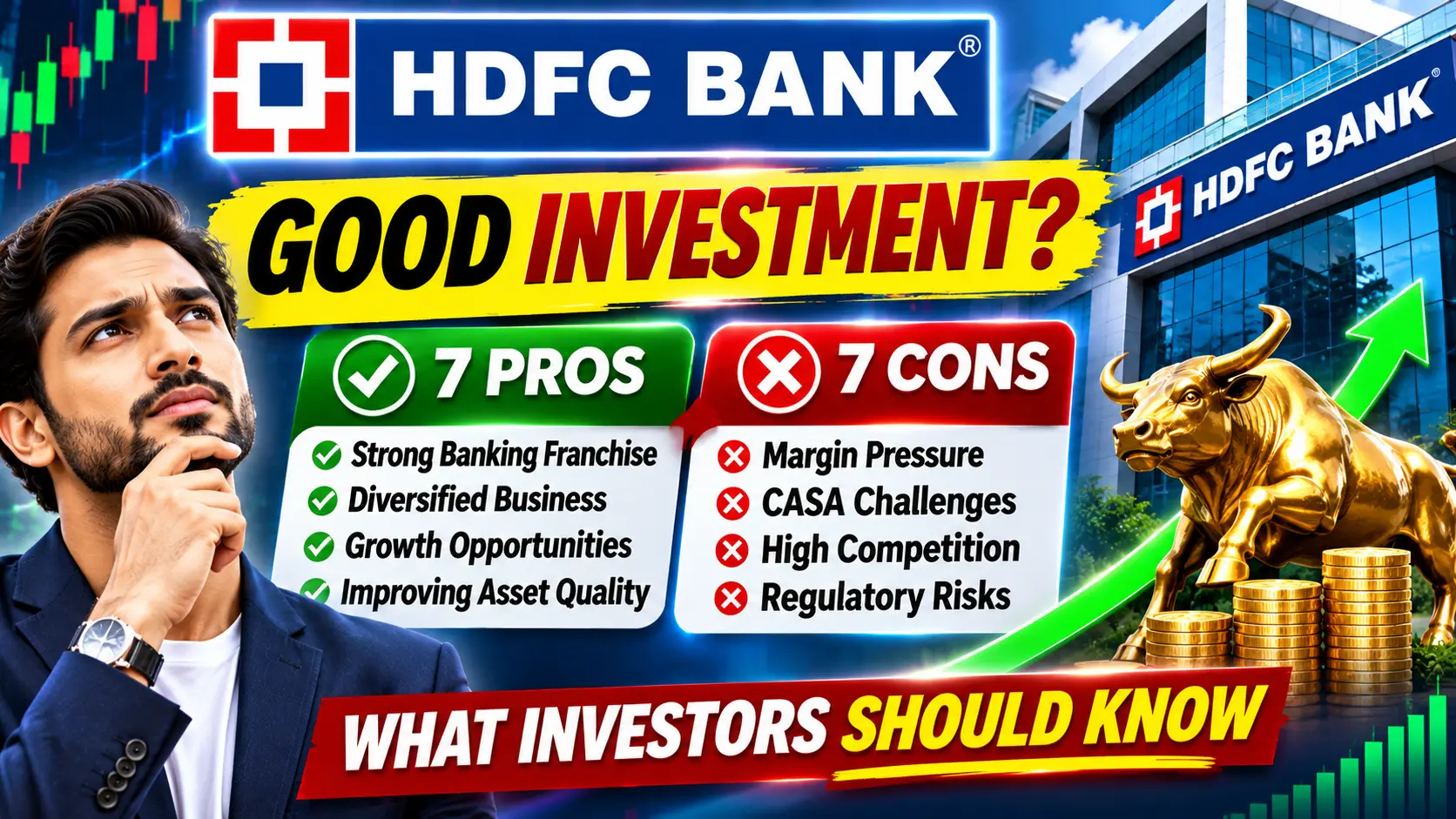
HDFC Bank Share: HDFC Bank is one of India’s most recognised private sector banking institutions, but is it still a good investment opportunity in November 2026? The bank has a strong customer franchise, extensive branch network, diversified financial services, and an established position in India’s banking industry. However, investors are also watching its profitability, deposit growth, net interest margins, and post-merger performance.
The pros and cons of investing in HDFC Bank have become particularly important as its share price has experienced considerable pressure over the past year, followed by a recent recovery in November 2026.
The bank’s leadership transition and efforts to improve operating performance could become important factors in determining its future growth.
Before considering HDFC Bank shares for a long-term portfolio, investors should understand both the opportunities and the risks.
Let’s examine the seven major investment considerations.
🏦 HDFC Bank: An Overview of India’s Banking Giant
<Entity value=”HDFC Bank” category=”company” disambig=”Indian private sector banking and financial services company”/> is one of India’s largest private sector banks, offering a wide range of financial products and services.
Its operations include:
- Retail banking
- Corporate and commercial banking
- Personal and business loans
- Credit cards and payment services
- Wealth management
- Digital banking
- Treasury and financial services
The bank benefits from an established brand, a large customer base, and a diversified banking franchise.
Its merger with HDFC Ltd also expanded the combined organisation’s financial services operations and changed its balance-sheet structure.
However, managing a larger banking business requires careful attention to funding costs, deposit growth, lending quality, and profitability.
🏦 HDFC Bank: Pros vs Cons
Key investment opportunities and risks to evaluate
🟢 Investment Advantages
🔴 Investment Risks
📈 7 Major Pros of Investing in HDFC Bank
1. Strong Banking Franchise and Brand Reputation
One of HDFC Bank’s biggest strengths is its established position in India’s financial services industry.
The bank has built a strong reputation through its retail banking services, corporate relationships, lending operations, and digital platforms.
A large customer base provides opportunities to cross-sell financial products, including loans, credit cards, insurance-related services, and investment products.
Its extensive distribution network also helps the bank reach customers across different economic segments.
A strong banking franchise can provide a competitive advantage, particularly when customers value reliability, service quality, and convenient banking facilities.
2. Diversified Revenue and Lending Business
HDFC Bank operates across several banking segments instead of depending on a single source of revenue.
Its business includes retail loans, corporate lending, commercial banking, credit cards, and transaction banking.
This diversification can help the bank manage changes in demand across individual lending categories.
For example, demand for home loans, vehicle loans, personal loans, and business financing may move differently depending on economic conditions.
A diversified portfolio can therefore provide opportunities for sustainable business growth.
However, investors should also monitor whether loan growth is supported by healthy deposits and appropriate lending standards.
3. Strong Long-Term Banking Growth Opportunity
India’s banking sector has considerable long-term growth opportunities.
Economic development, urbanisation, financial inclusion, digital payments, and rising household incomes can support demand for banking products.
HDFC Bank is positioned to participate in these developments through its existing customer relationships and financial services infrastructure.
The bank can also benefit from opportunities in retail lending, business banking, and digital financial services.
However, the actual benefits will depend on execution, competition, and the bank’s ability to maintain profitable growth.
4. Improving Asset Quality
Asset quality is one of the most important factors when evaluating a bank.
Non-performing assets (NPAs) represent loans where borrowers have stopped making scheduled repayments for a specified period.
Lower bad-loan levels generally indicate better credit quality, although investors should examine both gross and net NPAs.
Recent market analysis has highlighted improvement in HDFC Bank’s asset quality, with gross non-performing assets reported at approximately 1.10% in the November 2026 coverage.
Maintaining disciplined lending practices and effective recovery mechanisms will remain essential for protecting profitability.
5. Opportunities From Merger Synergies
The merger between HDFC Bank and HDFC Ltd created a larger financial services organisation.
The combined business offers opportunities to integrate customer relationships, lending operations, distribution channels, and financial products.
One important opportunity is the ability to offer banking products to customers who previously interacted with different parts of the organisation.
However, merger benefits do not happen automatically.
The bank must manage funding costs, balance-sheet efficiency, operating expenses, and deposit mobilisation to realise the full potential of the combined business.
6. Potential Valuation Recovery
HDFC Bank’s share price underperformance has attracted attention from investors looking for potential valuation opportunities.
A declining share price can make a stock more attractive if the company’s long-term fundamentals remain strong.
Recent November 2026 market coverage reported renewed buying interest in HDFC Bank shares, although the stock remained significantly below its earlier highs in the reported performance snapshot.
Some analysts believe that improving business performance and greater management clarity could support a future valuation recovery.
However, a low valuation alone does not make a stock a bargain. Investors must examine profitability, return on equity, growth prospects, and the price-to-book ratio.
7. New Leadership and Future Business Strategy
Leadership execution is another important factor for HDFC Bank.
The appointment of Anup Bagchi as the incoming managing director and chief executive officer has brought attention to the bank’s future strategic direction.
Investors will be watching how the new leadership addresses deposit growth, lending expansion, profitability, customer acquisition, and operational efficiency.
A successful leadership transition could improve confidence in the bank’s long-term strategy.
However, management changes can also create execution challenges, and investors should evaluate actual business results rather than relying only on expectations.
⚠️ 7 Major Cons and Risks of Investing in HDFC Bank
Despite its strengths, HDFC Bank is not a risk-free investment.
1. Pressure on Net Interest Margins
Net interest margin (NIM) measures the difference between interest earned on loans and investments and interest paid on deposits and borrowings, relative to earning assets.
Margin pressure can affect a bank’s profitability.
HDFC Bank must carefully balance lending rates with the cost of attracting deposits.
If deposit costs rise faster than lending yields, margins may remain under pressure.
2. CASA Deposit Growth Challenges
CASA stands for Current Account and Savings Account deposits.
These deposits are generally an important source of relatively low-cost funding for banks.
A decline in the CASA ratio can increase dependence on higher-cost term deposits.
This may increase funding expenses and put pressure on profitability.
Therefore, investors should closely monitor HDFC Bank’s deposit mix and its ability to attract stable retail deposits.
3. Strong Competition From Other Banks
HDFC Bank faces competition from several established private and public sector banks.
ICICI Bank, Axis Bank, Kotak Mahindra Bank, and other financial institutions compete across retail lending, corporate banking, credit cards, and digital services.
Smaller banks and non-banking financial companies also compete aggressively in selected lending segments.
To protect its market position, HDFC Bank must continue improving customer service, digital capabilities, product offerings, and operational efficiency.
4. Loan Growth May Remain Uneven
A bank’s profitability depends partly on its ability to grow loans while maintaining adequate funding.
If deposit growth does not keep pace with lending demand, the bank may need to adjust its credit expansion strategy.
Recent analyst commentary has identified the balance between loan growth and deposit growth as an important area to monitor.
Investors should examine advances, deposits, and the loan-to-deposit ratio together rather than looking at loan growth in isolation.
5. Leadership Transition and Execution Risk
A new CEO can bring fresh ideas and strategic priorities, but the transition also creates uncertainty.
Investors will want to understand how management plans to improve operating performance and whether existing business priorities will change.
Changes in senior management, internal processes, and strategic execution can affect business performance in the short term.
6. Regulatory and Compliance Risks
Banking is one of the most heavily regulated industries.
HDFC Bank must comply with Reserve Bank of India regulations, capital requirements, lending guidelines, cybersecurity standards, and customer protection rules.
Any significant compliance failure or regulatory restriction could affect business operations, reputation, and investor confidence.
7. Stock Market and Valuation Risks
Even financially strong banks can experience share-price declines during broader market corrections.
Changes in interest rates, foreign investor activity, economic growth, and banking-sector sentiment can influence valuations.
Investors who purchase HDFC Bank shares at an expensive valuation may experience disappointing returns even if the underlying business remains profitable.
🔍 Is HDFC Bank a Good Long-Term Investment in 2026?
HDFC Bank offers several characteristics that long-term investors may find attractive, including its banking franchise, diversified operations, customer relationships, and potential merger synergies.
However, the investment opportunity depends on whether the bank can translate these strengths into stronger earnings and sustainable profitability.
Three areas deserve particular attention:
- Deposit growth: Can the bank attract stable, low-cost deposits?
- Profitability: Can net interest margins and return ratios improve?
- Execution: Can the new leadership deliver consistent growth and operational efficiency?
Investors should also compare HDFC Bank’s valuation with competing banks and examine its financial results over several quarters.
A gradual investment approach may be more appropriate than making a large investment based on short-term market movements.
📊 HDFC Bank Investment Outlook: Pros vs Cons
The investment case presents both meaningful opportunities and important challenges.
Its established banking franchise and long-term industry position are positive factors. However, deposit costs, competition, margins, and management execution remain important risks.
Ultimately, investors should evaluate the bank using its actual financial performance rather than relying exclusively on its reputation or recent share-price recovery.
📝 Final Verdict: Should You Invest in HDFC Bank Shares?
HDFC Bank remains an important company to watch in India’s banking sector.
Its strong franchise, diversified financial services, and potential merger benefits provide a foundation for future growth. At the same time, margin pressure, deposit mobilisation, competition, and leadership execution could influence its financial performance.
The recent recovery in its share price has renewed investor interest, but a sustainable recovery will require improvement in the underlying business.
For long-term investors, the most important question is not simply whether HDFC Bank shares are cheaper than before. It is whether the bank can restore sustainable growth, improve profitability, and generate attractive returns for shareholders.
HDFC Bank could deserve a place on an investor’s research watchlist, but every investment decision should be based on independent research, valuation, and personal risk tolerance.
Disclaimer: This article is for educational and informational purposes only. It is not a recommendation to buy, sell, or hold HDFC Bank shares. Consult a SEBI-registered investment adviser before making financial decisions.
4. Frequently Asked Questions (FAQ)
❓ HDFC Bank Share: Frequently Asked Questions
1. Is HDFC Bank a good stock for long-term investment?
HDFC Bank may interest long-term investors because of its established banking franchise, diversified operations, and growth opportunities. However, investors should evaluate its profitability, deposit growth, valuation, and financial performance before investing.
2. What are the main advantages of investing in HDFC Bank?
Its major advantages include a strong banking franchise, diversified lending operations, established customer relationships, asset-quality management, and potential merger synergies.
3. What are the disadvantages of investing in HDFC Bank?
The main risks include net interest margin pressure, CASA deposit challenges, competition, loan-growth uncertainty, regulatory requirements, and leadership execution risks.
4. What is CASA in HDFC Bank?
CASA stands for Current Account and Savings Account. These deposits are generally an important source of relatively low-cost funding for banks.
5. Why is HDFC Bank’s net interest margin important?
Net interest margin measures how efficiently a bank earns interest from its assets relative to the cost of funding. Lower margins can affect earnings and profitability.
6. Who is the new CEO of HDFC Bank?
Anup Bagchi has been appointed as HDFC Bank’s incoming Managing Director and CEO. Investors will monitor his strategic priorities and execution as he takes charge.
7. What should investors check before buying HDFC Bank shares?
Investors should examine quarterly earnings, deposit growth, CASA ratio, gross and net NPAs, net interest margins, return on assets, return on equity, valuation, and management commentary.
8. Is HDFC Bank suitable for every investor?
No. Suitability depends on an investor’s financial objectives, investment horizon, risk tolerance, and portfolio diversification. A strong company is not automatically suitable at every share price.