

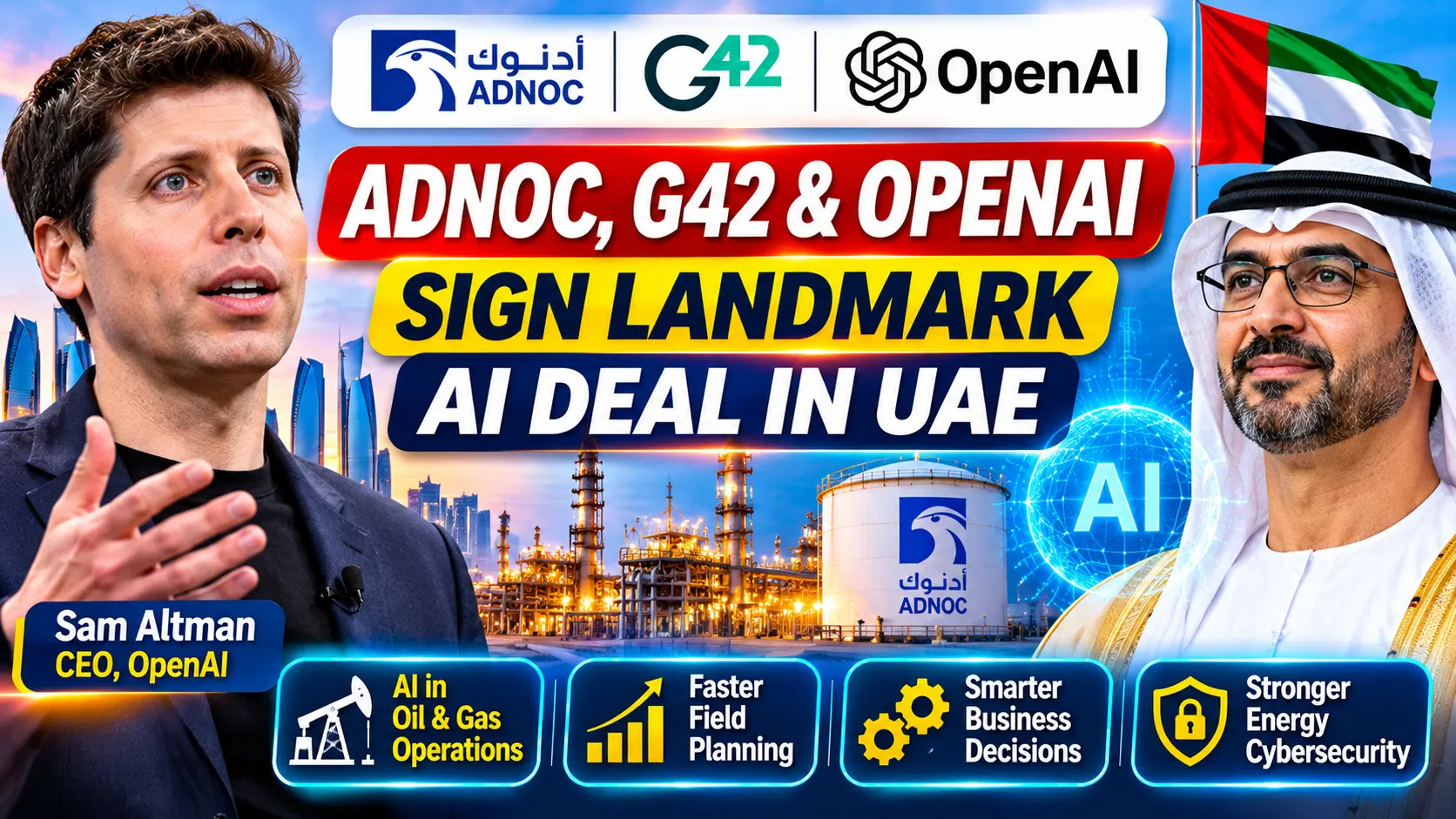
ADNOC: 🌍 The United Arab Emirates has taken another major step towards becoming a global artificial intelligence powerhouse after Abu Dhabi’s national energy company, ADNOC, signed a landmark multi-year partnership with OpenAI and artificial intelligence company G42. The agreement, announced on November 2, 2026, at the ADIPEC energy conference in Abu Dhabi, aims to bring advanced AI technology into the heart of energy operations.
The announcement is particularly significant because ADNOC is set to become the first energy company to deploy OpenAI’s frontier technology across complex business operations. The partnership will combine OpenAI’s advanced GPT models, ADNOC’s extensive industrial expertise and G42’s UAE-based AI infrastructure.
OpenAI CEO Sam Altman’s visit to the UAE added further importance to the announcement. During his visit, Altman met Abu Dhabi Crown Prince Sheikh Khaled bin Mohamed bin Zayed Al Nahyan, who witnessed the signing of agreements involving OpenAI and Abu Dhabi-based organisations.
The development highlights the growing relationship between artificial intelligence, energy infrastructure and international investment.
🤝 ADNOC, G42 and OpenAI Announce Landmark AI Partnership
The new agreement brings together three major players with complementary capabilities.
ADNOC contributes decades of energy-sector experience, industrial information and operational expertise. OpenAI provides advanced AI models and technology, while G42 supports the partnership through its UAE-based computing infrastructure.
The objective is to connect different parts of ADNOC’s business through intelligent AI systems capable of analysing complex information and supporting faster, more informed decisions.
Rather than limiting AI to individual departments, the partnership aims to connect operational, investment and commercial decision-making across the company’s energy value chain.
The technology will be deployed using OpenAI’s GPT models and G42’s sovereign AI infrastructure within the UAE.
An important element of the arrangement is human oversight. Experts will retain responsibility for consequential decisions, ensuring that AI supports professional judgement rather than automatically replacing it.
🌍 ADNOC × G42 × OpenAI
🤝 Three Major Technology Partners
Energy operations, industrial data and engineering expertise.
Advanced GPT models and frontier AI capabilities.
UAE-based sovereign AI computing infrastructure.
⚙️ How the AI Partnership Works
🚀 Key Areas of AI Transformation
Complex development planning targeted in hours rather than months.
Connected decisions across production, processing, refining and trading.
Support for identifying vulnerabilities and protecting critical energy infrastructure.
AI training and skills development for employees.
ADNOC is set to become the first energy company to deploy OpenAI Frontier technology. Human experts will retain oversight of consequential decisions.
🧠 What Is OpenAI Frontier and Why Is It Important?
OpenAI Frontier is an advanced platform designed to help organisations build, deploy and coordinate AI agents for complex business processes.
AI agents can analyse information, perform specialised tasks and work together across connected workflows.
In ADNOC’s case, the technology is intended to connect information from different areas of the energy business, helping decision-makers understand how one operational choice could affect other activities.
For example, a production decision may influence transportation requirements, refining economics, inventory planning and sales opportunities.
Traditionally, these decisions can involve separate teams and systems. An integrated AI approach could help bring relevant information together more quickly.
The partnership aims to develop a more connected decision-making environment rather than simply introduce another standalone chatbot.
🛢️ AI Could Transform ADNOC’s Oil and Gas Operations
One of the most important aspects of the agreement is its potential application in field master planning.
ADNOC plans to combine decades of industrial data covering thousands of wells, multiple reservoirs and hundreds of surface facilities.
The system will bring together geological, engineering, infrastructure, capital and commercial information to prepare and optimise complex field development plans.
According to ADNOC, this process could be completed in hours rather than months.
This represents an important opportunity for the energy industry because developing oil and gas fields involves numerous technical and financial considerations.
AI-supported analysis could help engineers compare development scenarios, identify operational constraints and evaluate investment choices more efficiently.
However, the technology is intended to support specialists, not eliminate the need for engineering expertise, safety procedures or human approval.
📊 AI to Help ADNOC Maximise the Value of Every Barrel
Another major application will focus on connecting decisions across the entire energy value chain.
ADNOC wants to integrate information from production, processing, refining, logistics, sales and trading.
Interconnected AI agents will analyse factors such as crude supply, market demand, prices and refining margins.
This could help the company understand the commercial consequences of operational decisions before they are implemented.
For example, an increase in production may not always represent the most profitable option if transportation costs, refining capacity or market conditions are unfavourable.
By analysing these factors together, AI could help decision-makers evaluate the value of each barrel across different stages of the business.
The long-term objective is to improve efficiency, strengthen commercial planning and make more informed decisions across ADNOC’s operations.
🇦🇪 Sam Altman’s UAE Visit Highlights Growing AI Cooperation
OpenAI CEO Sam Altman’s visit to Abu Dhabi coincided with the ADIPEC energy conference and the announcement of several agreements involving OpenAI and UAE-based organisations.
During the visit, Altman met Sheikh Khaled bin Mohamed bin Zayed Al Nahyan, Crown Prince of Abu Dhabi and Chairman of the Abu Dhabi Executive Council.
The meeting focused on opportunities to expand AI cooperation across government services and strategic economic sectors.
The agreements witnessed during the visit covered government, energy and investment.
The government initiative includes the development of an AI-native, machine-readable government approach. This reflects Abu Dhabi’s ambition to integrate AI more deeply into public administration and government services.
The wider announcements also involved investment-related cooperation with UAE entities, including Mubadala and G42’s Inception42.
These developments indicate that the UAE is interested in applying AI beyond consumer technology and into critical economic infrastructure.
🏢 ADNOC Already Has a Major AI and Robotics Programme
The latest partnership builds on ADNOC’s existing investments in artificial intelligence and automation.
According to the company’s announcement, its AI and robotics strategy already includes more than 200 AI applications and 70 robotics use cases that are deployed or under development.
The company also highlighted ENERGYai, a specialist AI system designed for complex subsurface workflows.
In addition, ADNOC has introduced ChatGPT Enterprise to more than 40,000 employees, with adoption exceeding 97%, according to its announcement.
These figures demonstrate that the company has been preparing its workforce and technology infrastructure for wider AI adoption.
The new partnership is intended to connect these capabilities and create a broader foundation for industrial AI.
🔐 Why UAE-Based AI Infrastructure Matters
The partnership also highlights the growing importance of sovereign AI infrastructure.
For governments and large industrial organisations, the location and governance of computing infrastructure can be important considerations.
Energy companies handle sensitive information related to production, infrastructure, commercial operations and national economic interests.
Using UAE-based AI infrastructure gives the partnership a framework for deploying the technology within the country’s computing environment.
Data governance, cybersecurity and operational oversight will remain essential as AI becomes more deeply integrated into critical industries.
ADNOC also announced plans to strengthen its cyber defence through OpenAI’s Daybreak Blue initiative, supporting security teams in identifying vulnerabilities and protecting critical energy infrastructure.
🚀 What Does the ADNOC OpenAI Deal Mean for the Future of AI?
The partnership could become an important example of how frontier AI technology is applied in traditional industries.
For years, artificial intelligence has attracted attention through chatbots, image generation and productivity tools. Its industrial applications could have an equally significant impact.
In the energy sector, AI has the potential to improve planning, maintenance, resource management, operational efficiency and commercial decision-making.
The ADNOC agreement could encourage other energy companies to explore similar approaches.
It also strengthens the UAE’s position as an international centre for AI infrastructure, enterprise technology and industrial innovation.
Nevertheless, successful implementation will depend on data quality, cybersecurity, workforce training, regulatory compliance and the reliability of AI-generated recommendations.
The technology must deliver measurable improvements rather than simply generate excitement around artificial intelligence.
⚠️ Challenges and Risks of AI in the Energy Industry
Despite the potential benefits, deploying advanced AI across critical energy infrastructure presents several challenges.
Data security: Energy companies must protect sensitive operational and commercial information.
Accuracy: AI systems must produce reliable outputs, particularly when supporting decisions involving expensive industrial assets.
Human supervision: Engineers and business leaders must retain oversight of important operational and investment decisions.
Integration: Connecting decades of industrial data with modern AI systems requires substantial technical work.
Workforce development: Employees need training to understand, evaluate and effectively use AI tools.
Managing these challenges will be essential to turning the partnership’s ambitions into practical business results.
Conclusion: A New Chapter for AI and the Global Energy Industry
The ADNOC, G42 and OpenAI partnership represents an important development in the relationship between artificial intelligence and the global energy industry.
By combining advanced GPT models, sovereign AI infrastructure and extensive industrial expertise, the partners aim to improve planning, connect business decisions and increase operational efficiency.
Sam Altman’s UAE visit and the wider agreements involving Abu Dhabi organisations also demonstrate the country’s growing ambitions in artificial intelligence.
While the long-term results will depend on successful implementation, the announcement sends a clear message: AI is moving beyond traditional software applications and becoming an increasingly important part of the infrastructure supporting major industries.
For the global energy sector, the ADNOC partnership could provide an important example of what industrial AI adoption may look like in the coming years.
Frequently Asked Questions (FAQs)
1. What is the ADNOC and OpenAI partnership?
ADNOC, OpenAI and G42 have signed a multi-year agreement to deploy advanced AI capabilities across ADNOC’s energy operations, connecting operational, investment and commercial decision-making.
2. Why did ADNOC partner with OpenAI and G42?
The partnership aims to combine OpenAI’s advanced GPT models, ADNOC’s industrial expertise and G42’s UAE-based AI infrastructure to improve efficiency and business decisions.
3. What is OpenAI Frontier?
OpenAI Frontier is an AI platform designed to help organisations build, deploy and coordinate AI agents across complex business workflows.
4. What is Sam Altman doing in the UAE?
OpenAI CEO Sam Altman visited Abu Dhabi on November 2, 2026, where he met Crown Prince Sheikh Khaled bin Mohamed bin Zayed Al Nahyan and participated in discussions surrounding AI cooperation and agreements.
5. How will artificial intelligence help ADNOC’s oil operations?
AI is expected to support field development planning, reservoir analysis, production decisions, refining, logistics and commercial optimisation.
6. Will AI replace human workers at ADNOC?
The announcement focuses on improving decision-making and productivity. It also confirms that human experts will retain oversight of consequential decisions. It does not announce a workforce replacement programme.
7. Why is the UAE investing heavily in artificial intelligence?
The UAE aims to strengthen its position as a global AI hub, diversify its economy, develop digital infrastructure and apply advanced technology across government and major industries.
Final Takeaway
The landmark ADNOC, G42 and OpenAI agreement is more than a technology announcement. It represents a major step towards connecting artificial intelligence with real-world industrial operations.
As AI adoption expands across energy, government and investment, the UAE is positioning itself at the centre of a new wave of technology-driven economic transformation.