

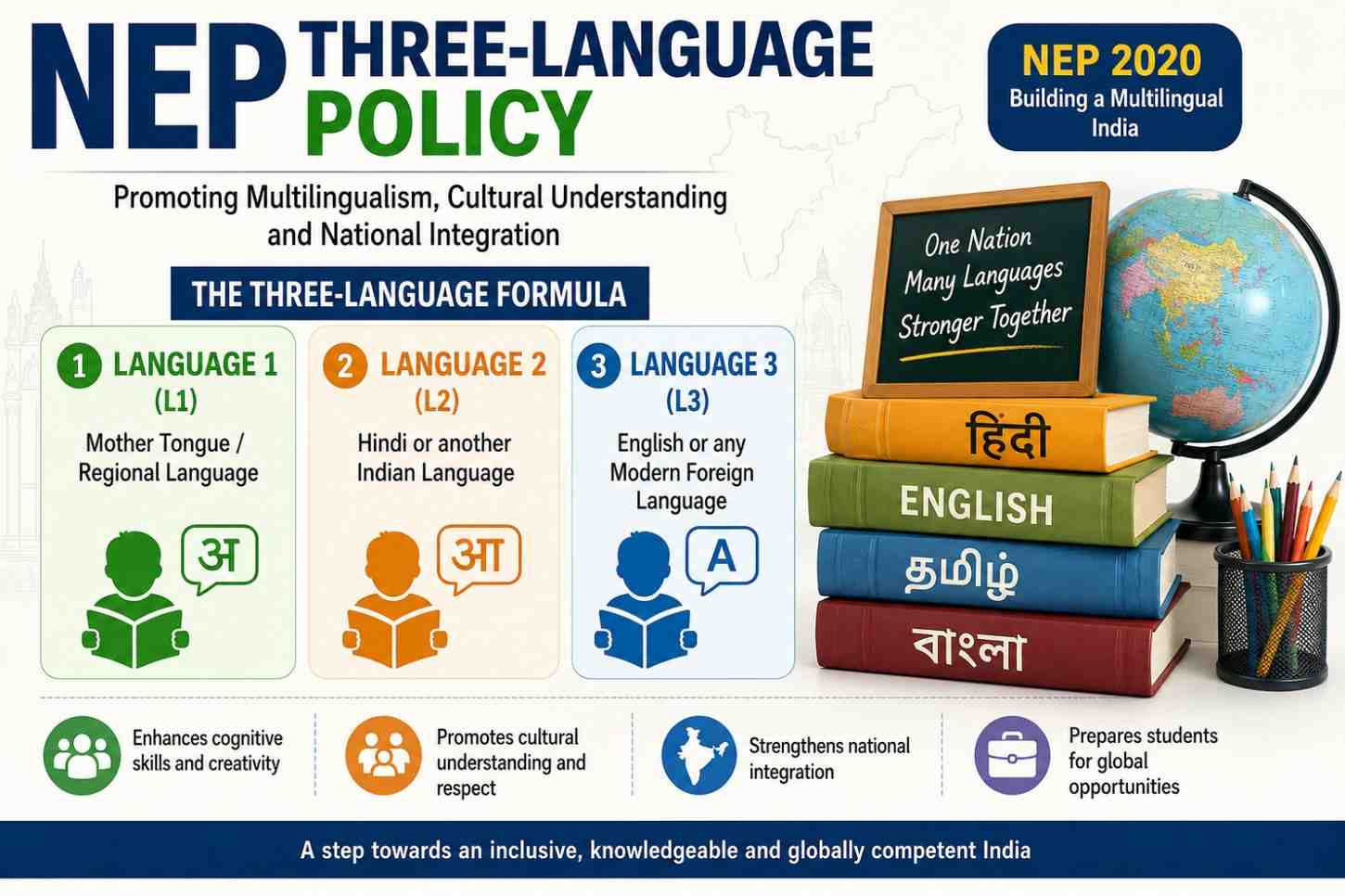
NEP Three-Language Policy: The Centre, the Central Board of Secondary Education (CBSE), and the National Council of Educational Research and Training (NCERT) have strongly defended the National Education Policy (NEP) 2020’s three-language policy before the Supreme Court, arguing that it is aimed at promoting multilingualism, national integration, and quality education across India.
In separate affidavits filed before the apex court, the three authorities urged the court to dismiss petitions challenging the implementation of the policy in CBSE-affiliated schools, maintaining that the reforms are academically sound and constitutionally valid.
📌 Key Highlights
- ✅ Centre, CBSE and NCERT defend the NEP 2020 three-language policy in the Supreme Court.
- ✅ Government says the policy promotes multilingualism and national integration.
- ✅ Current Class 10 students (2026-27) will continue with the existing two-language system.
- ✅ Foreign languages like French, German and others remain available under the revised curriculum.
- ✅ CBSE says the policy includes transition relaxations so that no student is disadvantaged.
- ✅ NCERT confirms learning materials are ready in 22 Scheduled Languages.
⚖️ Supreme Court Hears Fresh Challenge to NEP Three-Language Policy
A Bench headed by Chief Justice of India Surya Kant on Tuesday sought responses from the Centre, CBSE and NCERT on fresh petitions challenging the implementation of the three-language framework for students studying in Class 9.
The petitions question the CBSE’s policy requiring students to study three languages, including at least two Indian languages, under the National Education Policy.
🇮🇳 Centre: Three-Language Policy Promotes National Integration
In its affidavit, the Union Ministry of Education said the language policy is a key component of the National Education Policy (NEP) 2020 and is designed to encourage multilingual learning while strengthening India’s linguistic diversity.
According to the ministry, the National Curriculum Framework for School Education (NCFSE) 2023 recommends that students study three languages from Classes 6 to 10, with at least two being native Indian languages.
The government stated that the policy aims to:
- 🌍 Promote multilingual education
- 🇮🇳 Strengthen national integration
- 📚 Preserve India’s linguistic heritage
- 🎓 Develop globally competitive students with strong Indian values
The ministry argued that language education forms an integral part of broader educational reforms envisioned under the NEP.
📚 CBSE: Policy Introduced Through a Phased and Student-Friendly Process
CBSE told the Supreme Court that the three-language policy has been rolled out through a planned, phased and systematic implementation process.
The Board stressed that curriculum design, language selection, teaching methods and examinations fall within the domain of educational experts and should receive limited judicial interference.
CBSE also informed the court that concerns raised by petitioners have already been addressed through guidelines issued on June 29 and July 10, which provide:
- ✔️ Transitional relaxations
- ✔️ Student safeguards
- ✔️ Exemptions where necessary
- ✔️ Flexible implementation measures
The Board said these steps ensure that no student suffers due to the transition.
🎓 No Third Language for Current Class 10 Students
One of the biggest clarifications made by CBSE concerns students currently studying in Class 10 during the 2026-27 academic session.
According to the affidavit:
- ✅ Current Class 10 students will continue under the existing two-language system.
- ✅ They will not be required to study a third language.
For students appearing in the 2027-28 Class 10 Board Examination, the third language (R3) will be assessed only through internal school-based evaluation, with no separate board examination paper.
🌍 Foreign Languages Have Not Been Removed, Says CBSE
Rejecting one of the major allegations made in the petitions, CBSE said claims that foreign languages have been eliminated are “factually incorrect.”
The Board clarified that:
- 🌐 Foreign languages can still be studied as one of the three languages, provided the other two are Indian languages.
- 📖 Students may also choose a foreign language as an additional fourth language.
Students who had already opted for two foreign languages, such as English and French, have been granted a one-time relaxation. They can continue studying both while adding one Bharatiya Bhasha (Indian language) as the third language.
👩🏫 CBSE Addresses Concerns Over Teachers and Learning Resources
CBSE also dismissed concerns regarding the availability of qualified teachers and textbooks.
The Board informed the Supreme Court that schools can adopt flexible arrangements, including:
- 👨🏫 Existing teachers with language proficiency
- 🎓 Qualified postgraduate teachers
- 👴 Retired educators
- 🏫 Resource sharing among Sahodaya school clusters
- 💻 Online and hybrid teaching methods
The Board added that students whose parents move to another state will receive flexibility in continuing their chosen language combination.
📖 NCERT Says Learning Material Ready in 22 Scheduled Languages
Defending the policy, NCERT stated that it has completed the academic and administrative process for preparing R3 Language Learning Resource Material for Class 9 in all 22 Scheduled Languages.
According to NCERT Director Professor Dinesh Prasad Saklani, learning material has already been developed for:
- 📘 Hindi
- 📙 Sanskrit
- 📗 Marathi
- 📕 Urdu
The textbooks and learning resources have already been uploaded to the NCERT website, with work continuing for other languages.
NCERT said the reforms are intended to promote:
- 📚 Competency-based learning
- 🌐 Multilingual education
- 👧 Age-appropriate pedagogy
- 🇮🇳 Appreciation of India’s linguistic and cultural diversity
⚖️ CBSE Defends Constitutional Validity
CBSE argued that its May 15 circular implementing the three-language policy is fully consistent with the Constitution.
The Board told the Supreme Court that the policy:
- ✔️ Is not arbitrary
- ✔️ Is not discriminatory
- ✔️ Does not violate Articles 14, 19(1)(g), 21, 21A or 29 of the Constitution
According to the Board, the policy balances educational reform with adequate safeguards for students.
📌 What Happens Next?
The Supreme Court will now examine the affidavits filed by the Centre, CBSE and NCERT while hearing the petitions challenging the implementation of the NEP 2020 three-language policy.
The outcome of the case could have a significant impact on language education in CBSE-affiliated schools across India.
🔎 FAQs
What is the NEP three-language policy?
The NEP 2020 recommends that students study three languages during Classes 6 to 10, with at least two being Indian languages.
Will current Class 10 students have to study a third language?
No. CBSE has clarified that students currently in Class 10 (2026-27) will continue under the existing two-language system.
Are foreign languages being removed?
No. CBSE has informed the Supreme Court that foreign languages remain part of the curriculum and can be studied either as one of the three languages or as an additional fourth language.
Why is the policy being challenged?
Petitioners have questioned the implementation of the policy, including concerns over language choice, constitutional validity and practical implementation. The Centre, CBSE and NCERT have opposed these pleas in the Supreme Court.
Keypoints: NEP Three-Language Policy, Supreme Court, CBSE three-language policy, NEP 2020, NCERT, Ministry of Education, National Education Policy, Class 9 language policy, Class 10 language rule, CBSE latest news, Education News India.