

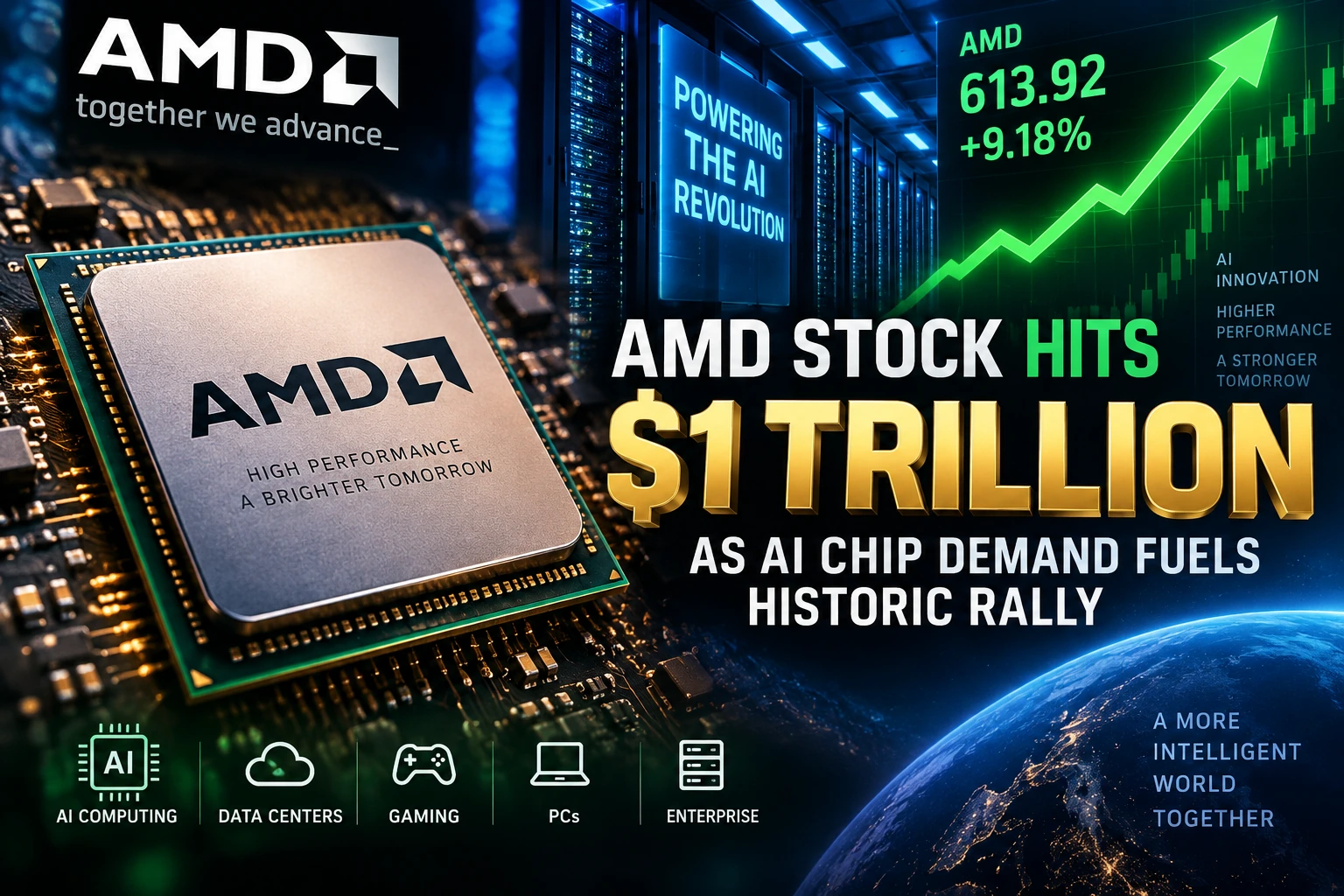
AMD Stock Hits $1 Trillion as AI Chip Demand Fuels Historic Rally: AMD shares surge to record highs as artificial intelligence transforms the semiconductor industry and intensifies competition with Nvidia. Advanced Micro Devices (NASDAQ: AMD) reached a historic milestone on Monday, September 21, 2026, as its stock surged to a record high, briefly pushing the semiconductor company’s market capitalization above $1 trillion for the first time.
AMD shares climbed more than 9% during the trading session, reaching an intraday high of $613.92. The rally reflects growing investor interest in the company’s expanding role in artificial intelligence, high-performance computing, and data center infrastructure.
The milestone places AMD among a select group of American semiconductor companies that have achieved trillion-dollar valuations.
However, the company’s market value fluctuated around the $1 trillion threshold during the session, meaning an intraday crossing did not necessarily guarantee a closing valuation above that level.
📌 Key Takeaways
- AMD stock reached an intraday record high of $613.92 on September 21, 2026.
- The company’s market capitalization briefly surpassed $1 trillion.
- Growing demand for artificial intelligence infrastructure is supporting investor interest in AMD.
- AMD is expanding its AI computing business as it competes with Nvidia.
- The semiconductor industry’s broader rally highlights continued investor attention to AI-related hardware.
📈 AMD Stock Price Surges to Record High
AMD experienced a significant rally on September 21, with shares rising approximately 9% and briefly exceeding the $613 level.
The stock’s upward movement extended an impressive performance throughout 2026.
According to Reuters, AMD shares had gained approximately 185% during the year at the time of its report, substantially outperforming the Nasdaq Composite Index’s approximately 15.8% advance.
The company’s market capitalization also increased dramatically compared with the previous year, when its valuation stood at approximately $255 billion.
The rapid increase illustrates how investor expectations for AMD have changed as artificial intelligence becomes an increasingly important part of its business.
What Does AMD’s $1 Trillion Market Cap Mean?
Market capitalization represents the total market value of a company’s outstanding shares.
It is calculated by multiplying the current share price by the number of shares outstanding.
For example, a company with 1 billion outstanding shares trading at $100 per share would have a market capitalization of $100 billion.
AMD reaching the $1 trillion threshold reflects the market’s valuation of its existing operations and expectations for its future financial performance.
However, market capitalization does not represent the amount of cash a company holds or the revenue it generates.
🤖 Why Is AMD Stock Rising? AI Demand Drives Growth Expectations
One of the primary factors behind AMD’s stock rally is investor enthusiasm for artificial intelligence infrastructure.
Companies developing AI applications require substantial computing power to train and operate increasingly sophisticated models.
This creates demand for specialized processors, networking equipment, memory, and complete computing systems.
AMD participates in this market through its graphics processing units, server processors, and broader data center technology.
The company has also accelerated AI product launches and expanded beyond individual chips into more complete computing systems.
These developments have strengthened its position as a competitor in the growing AI hardware market.
AI Data Centers Create New Opportunities
Modern AI data centers use different types of processors to handle complex computing workloads.
Graphics processing units, or GPUs, perform many calculations simultaneously, making them useful for training and running AI models.
Central processing units, or CPUs, handle a wide range of general computing tasks and work alongside GPUs in AI servers.
AMD supplies both types of processors.
The increasing use of AI inference—the process of running trained AI models to generate responses—has supported demand for server CPUs.
Reuters reported that this demand has helped AMD gain market share from Intel in the server processor market.
⚔️ AMD vs Nvidia: Competition in the AI Chip Market
AMD’s growing market valuation has intensified attention on its competition with Nvidia.
Nvidia has established a substantial presence in AI computing through its GPUs, software ecosystem, and data center infrastructure.
AMD is pursuing opportunities in the same market by expanding its AI hardware offerings and developing integrated computing solutions.
Rather than focusing exclusively on individual processors, AMD is combining CPUs, GPUs, networking equipment, and related technologies into larger systems.
This approach allows the company to address customers seeking complete AI computing infrastructure.
Can AMD Challenge Nvidia’s AI Business?
AMD’s ability to expand its AI business will depend on several factors, including product performance, software compatibility, pricing, manufacturing capacity, and customer adoption.
Nvidia’s established software ecosystem remains an important consideration for businesses choosing AI hardware.
AMD, meanwhile, has opportunities to attract customers interested in alternative hardware suppliers and diversified computing infrastructure.
The long-term financial impact will depend on how successfully AMD converts demand for its technology into revenue, earnings, and sustainable profitability.
💰 Semiconductor Stocks Rally Alongside AMD
AMD was not the only semiconductor company experiencing strong investor demand on September 21.
Shares of Intel and Qualcomm also advanced as technology stocks participated in a broader market rally.
Reuters reported that Intel shares rose approximately 11.8%, while Qualcomm gained around 4.5% during the session.
The Philadelphia Semiconductor Index advanced approximately 2.7%, reaching its highest level in more than a month.
The gains suggest that investors were responding to broader expectations for semiconductor demand rather than focusing exclusively on AMD.
Why Are Investors Interested in Semiconductor Companies?
Semiconductors are essential components in smartphones, computers, cloud infrastructure, electric vehicles, and artificial intelligence systems.
The expansion of AI infrastructure creates demand across multiple areas of the semiconductor supply chain.
However, different companies face different opportunities and risks depending on their products, customers, manufacturing capabilities, and competitive positions.
A broader industry rally does not guarantee that every semiconductor company will experience the same financial results.
⚠️ What Should Investors Watch After AMD’s $1 Trillion Milestone?
Although AMD’s historic valuation highlights growing enthusiasm for its AI business, investors should distinguish stock market momentum from underlying financial performance.
Several developments could influence the company’s future share price.
1. AI revenue growth: Investors will be watching whether AMD can translate demand for its processors and computing systems into sustained revenue growth.
2. Competition: Nvidia, Intel, and other semiconductor companies continue to develop products that compete across AMD’s markets.
3. Profitability: Higher revenue does not automatically produce higher earnings. Research spending, manufacturing costs, pricing, and operating expenses can affect profitability.
4. Valuation: A rapidly rising stock price can increase the expectations already reflected in a company’s market value.
5. Economic conditions: Interest rates, technology spending, supply chain disruptions, and broader financial market conditions can influence semiconductor stocks.
Reuters reported that AMD was trading at approximately 41 times its expected earnings over the following 12 months at the time of its September 21 report.
That valuation illustrates the importance of future earnings growth in assessing the company’s share price.
❓ Frequently Asked Questions About AMD Stock
1. Did AMD stock reach a $1 trillion market cap?
Yes. AMD briefly surpassed a $1 trillion market capitalization during trading on September 21, 2026, after its shares reached record highs. The company’s valuation fluctuated around that threshold during the session.
2. Why did AMD stock rise so much?
The rally was associated with renewed investor interest in artificial intelligence, growing demand for AI computing infrastructure, and AMD’s expanding semiconductor business.
3. What was AMD’s highest stock price on September 21, 2026?
AMD shares reached a reported intraday high of $613.92 during the September 21 trading session, according to Reuters reporting republished by Channel News Asia.
4. Is AMD a competitor to Nvidia?
Yes. AMD competes with Nvidia in graphics processors, AI accelerators, and data center computing. Both companies develop hardware used in artificial intelligence applications.
5. Does AMD’s $1 trillion valuation mean its stock will continue rising?
No. Market capitalization reflects the current market value of a company’s shares, not a guarantee of future performance. AMD’s future stock price will depend on its financial results, competitive position, investor expectations, and broader market conditions.
🎯 Final Thoughts: AMD Enters a New Era of AI Computing
AMD’s achievement of a $1 trillion market capitalization marks an important moment in the company’s history.
Its expanding AI computing portfolio, growing data center presence, and competition with Nvidia have contributed to increased investor attention.
The milestone also highlights the semiconductor industry’s role in supporting artificial intelligence infrastructure.
However, AMD’s long-term performance will depend on its ability to convert technological progress and customer demand into sustainable financial results.
For investors and technology enthusiasts, AMD’s trillion-dollar milestone represents a significant development in the rapidly evolving AI semiconductor market.