

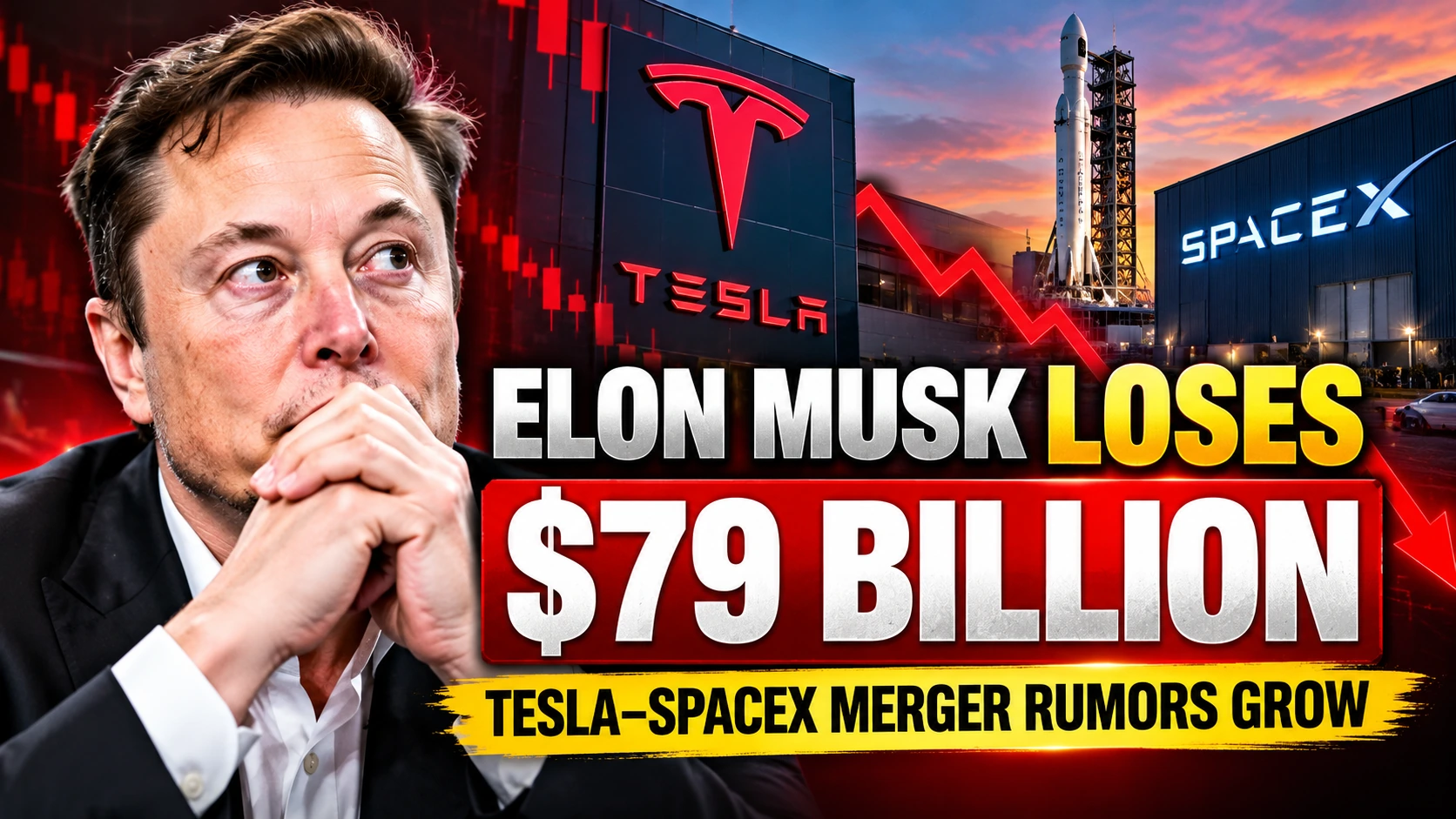
Elon Musk: Elon Musk’s net worth has reportedly fallen by approximately $79 billion in just four trading days, highlighting the extraordinary volatility surrounding Tesla and SpaceX. According to financial reports, the billionaire’s estimated fortune dropped from around $1 trillion to $921 billion as shares in both companies weakened.
The dramatic decline comes as Wall Street renews speculation about a potential Tesla-SpaceX merger. Analysts believe combining Musk’s electric vehicle, artificial intelligence, robotics, and space businesses could create a powerful technology group. However, no completed merger has been announced, and investors remain concerned about financing requirements, market valuations, and shareholder approval.
📉 Elon Musk’s Net Worth Drops $79 Billion in Four Trading Days
Elon Musk has experienced another significant fluctuation in his estimated personal fortune as technology stocks face selling pressure.
Reports citing the Bloomberg Billionaires Index indicate that Musk’s wealth declined by approximately $79 billion over four trading sessions, bringing his estimated net worth to $921 billion.
The decline followed a period in which his fortune had reportedly recovered to the $1 trillion level.
Although the numbers are enormous, they do not mean Musk lost $79 billion in cash. Most of his wealth is connected to ownership stakes in companies whose market values change daily.
When investors reduce their expectations for these businesses, the estimated value of his holdings can fall sharply.
This makes Musk’s fortune particularly sensitive to fluctuations in Tesla and SpaceX shares.
Why Did Elon Musk’s Wealth Fall?
Several factors contributed to the reported decline:
- 📉 Falling share prices at Tesla and SpaceX.
- 💰 Concerns about financing major artificial intelligence projects.
- 🤖 Uncertainty surrounding technology-sector valuations.
- 📊 Broader selling pressure across growth stocks.
- 🚀 Investor questions about future expansion costs.
The developments demonstrate how quickly market sentiment can influence even the world’s wealthiest individuals.
📊 Elon Musk’s $79 Billion Wealth Decline
Reported October 2026 estimates | USD
Source: Financial reports dated October 16, 2026. Figures are estimates, not live market data. Net worth fluctuates with asset valuations.
🚗 Tesla Stock Declines as Investors Reassess Growth Expectations
Tesla shares have faced pressure as investors reconsider the company’s valuation and future earnings potential.
According to the October 16 financial report, Tesla declined 1.29% during the October 15 trading session, extending its weekly loss to approximately 5.29%.
The weakness came despite renewed attention surrounding the company’s next-generation Roadster.
Tesla’s long-term investment story increasingly extends beyond electric vehicles. Investors are also evaluating its ambitions in autonomous driving, robotaxis, artificial intelligence, and humanoid robotics.
However, ambitious technological projects require substantial investment, and their commercial success remains uncertain.
Tesla must demonstrate that its spending can eventually translate into sustainable revenue and profitability.
Tesla Earnings Could Become the Next Major Catalyst
Tesla’s third-quarter earnings report is scheduled for October 21, 2026.
Investors will closely examine vehicle deliveries, automotive profit margins, operating expenses, and management’s expectations for future growth.
Any significant changes in profitability or investment plans could influence the stock’s direction.
The earnings announcement may also provide additional information about Tesla’s collaboration with other companies in Musk’s business portfolio.
🚀 SpaceX Shares Slide Amid Financing Concerns
SpaceX has also faced selling pressure, according to the financial reports.
The company reportedly declined 2.33% on October 15, taking its weekly loss to approximately 8.58%.
The reports also describe seven consecutive trading sessions of falling shares.
One major concern involves the substantial funding required to expand artificial intelligence infrastructure.
A reported $40 billion financing proposal has attracted attention because large capital-raising plans can affect investor expectations.
While additional funding may support long-term expansion, shareholders must consider how the money will be used and whether future returns will justify the investment.
For companies pursuing expensive technological projects, financial discipline remains an important consideration.
🔥 Tesla Roadster Reveal Revives Merger Speculation
Despite the recent market weakness, Tesla’s redesigned Roadster has generated excitement among technology enthusiasts and investors.
The vehicle’s demonstration highlighted engineering collaboration between Tesla and SpaceX, particularly through rocket-inspired thruster technology.
The unusual combination of automotive and aerospace engineering renewed discussions about whether Musk might eventually combine the two businesses.
A merger could potentially bring electric vehicles, autonomous transportation, robotics, satellite communications, and artificial intelligence development under a more integrated corporate structure.
However, technological cooperation does not automatically mean a merger will occur.
A formal agreement would require negotiations, regulatory considerations, and potentially shareholder votes.
🤝 Why Wall Street Is Discussing a Tesla-SpaceX Merger
Barclays analysts have explored a possible combination of Tesla and SpaceX, with artificial intelligence emerging as a central strategic consideration.
Tesla is investing in physical AI applications, including autonomous vehicles and humanoid robots.
SpaceX operates in aerospace, satellite communications, and related advanced technology infrastructure.
Supporters of a merger believe combining these capabilities could create operational advantages.
Potential Benefits of Combining Tesla and SpaceX
1. Artificial intelligence integration
The businesses could coordinate AI infrastructure and research more closely, potentially reducing duplication.
2. Advanced semiconductor development
Joint technology initiatives could support specialized chips for vehicles, robots, satellites, and computing systems.
3. Engineering collaboration
Tesla and SpaceX could share selected expertise in manufacturing, software, and complex engineering.
4. Capital allocation
A combined organization might coordinate major investment decisions across different business divisions.
5. Corporate leadership
A merger could simplify some ownership and decision-making arrangements, although governance questions would remain important.
These benefits are possibilities rather than guaranteed outcomes.
💰 Could SpaceX Acquire Tesla in an All-Stock Deal?
One scenario discussed by analysts involves SpaceX acquiring Tesla through an all-stock transaction.
Under such an arrangement, shareholders would receive equity in the combined business instead of a conventional cash payment.
The structure could allow Musk to retain substantial influence over the new organization.
Analysts have also examined how different voting-share arrangements might affect his control.
However, the final ownership percentages would depend on the agreed valuations, exchange ratio, and corporate structure.
A potential announcement before Tesla’s December shareholder meeting has been discussed, but this remains an analyst scenario rather than a confirmed transaction.
Major Obstacles to a Merger
A deal of this scale could face several challenges.
Shareholder approval would be a major consideration, especially if investors disagreed about the relative valuations of the two companies.
Regulators could also examine competition, corporate governance, and other legal implications.
Investors would need to understand how the combined company would operate and whether the expected benefits outweigh the risks.
Until a formal agreement is announced, the proposed merger should be treated as speculation.
📊 Elon Musk Wealth Decline: Key Financial Figures
The following figures summarize the October 16 reports and should be understood as time-specific estimates.
| Financial indicator | Reported figure |
|---|---|
| Musk’s estimated wealth before decline | $1 trillion |
| Reported four-day wealth decline | $79 billion |
| Estimated wealth after decline | $921 billion |
| Tesla weekly share decline | 5.29% |
| SpaceX weekly share decline | 8.58% |
| Reported SpaceX financing proposal | $40 billion |
| Tesla Q3 earnings date | October 21, 2026 |
These figures are not live market quotations. Estimated personal wealth can change significantly as share prices and private asset valuations fluctuate.
🤖 Could Artificial Intelligence Drive the Next Phase of Growth?
Artificial intelligence has become a central theme connecting several of Musk’s businesses.
Tesla is developing technology for autonomous transportation and robotics, while SpaceX is pursuing infrastructure that could support increasingly sophisticated digital systems.
A combined strategy might offer opportunities to share computing resources, research, and specialized hardware.
However, AI infrastructure requires enormous spending on chips, electricity, facilities, and engineering.
Investors must distinguish between long-term technological potential and the financial performance currently demonstrated by each company.
Rapid expansion can create significant opportunities, but it can also increase operating costs and financial risk.
🔮 What Should Tesla and SpaceX Investors Watch Next?
Several developments could influence market sentiment in the coming weeks.
Tesla’s upcoming quarterly earnings will provide an important indication of its financial performance.
Investors will also monitor SpaceX financing developments, management comments, and any formal announcements about closer corporate integration.
The broader technology market remains another important factor.
If concerns about AI spending continue, even companies with strong long-term growth prospects may experience volatility.
Conversely, improving profitability, credible investment plans, or positive operational results could support investor confidence.
For now, the central question is whether Musk’s businesses can translate ambitious technology projects into sustainable financial returns.
❓ Frequently Asked Questions
1. How much money did Elon Musk reportedly lose?
Financial reports dated October 16, 2026, estimate that Musk’s net worth declined by approximately $79 billion over four trading days.
2. What is Elon Musk’s reported net worth after the decline?
The reports place his estimated fortune at approximately $921 billion. This is a historical estimate, not a live net-worth figure.
3. Why did Tesla and SpaceX shares fall?
Reports point to broader technology-sector selling, concerns about artificial intelligence spending, and uncertainty surrounding financing and valuations.
4. Are Tesla and SpaceX officially merging?
No completed merger has been announced in the reporting reviewed. Analysts have discussed potential transaction structures and timelines, but speculation should not be confused with a confirmed deal.
5. When is Tesla’s next earnings report?
Tesla is scheduled to release its third-quarter financial results on October 21, 2026, according to the reports reviewed.
✅ Conclusion: Musk’s Wealth Decline Highlights Market Volatility
Elon Musk’s reported $79 billion wealth decline illustrates how dramatically market valuations can influence the fortunes of major technology entrepreneurs.
Tesla and SpaceX remain central to his business interests, but both face investor questions about financing, profitability, and the enormous costs of future innovation.
At the same time, speculation surrounding a possible Tesla-SpaceX merger has introduced another important dimension to the investment discussion.
While analysts see potential advantages in combining the companies, significant financial, regulatory, and governance questions remain unresolved.
The coming weeks could provide greater clarity through Tesla’s earnings announcement, SpaceX financing developments, and any official statements about a possible merger.
For investors, the most important distinction is between ambitious future possibilities and confirmed business results.
Disclaimer: This article is for informational purposes only and does not constitute investment advice. Financial estimates and share prices may change.