

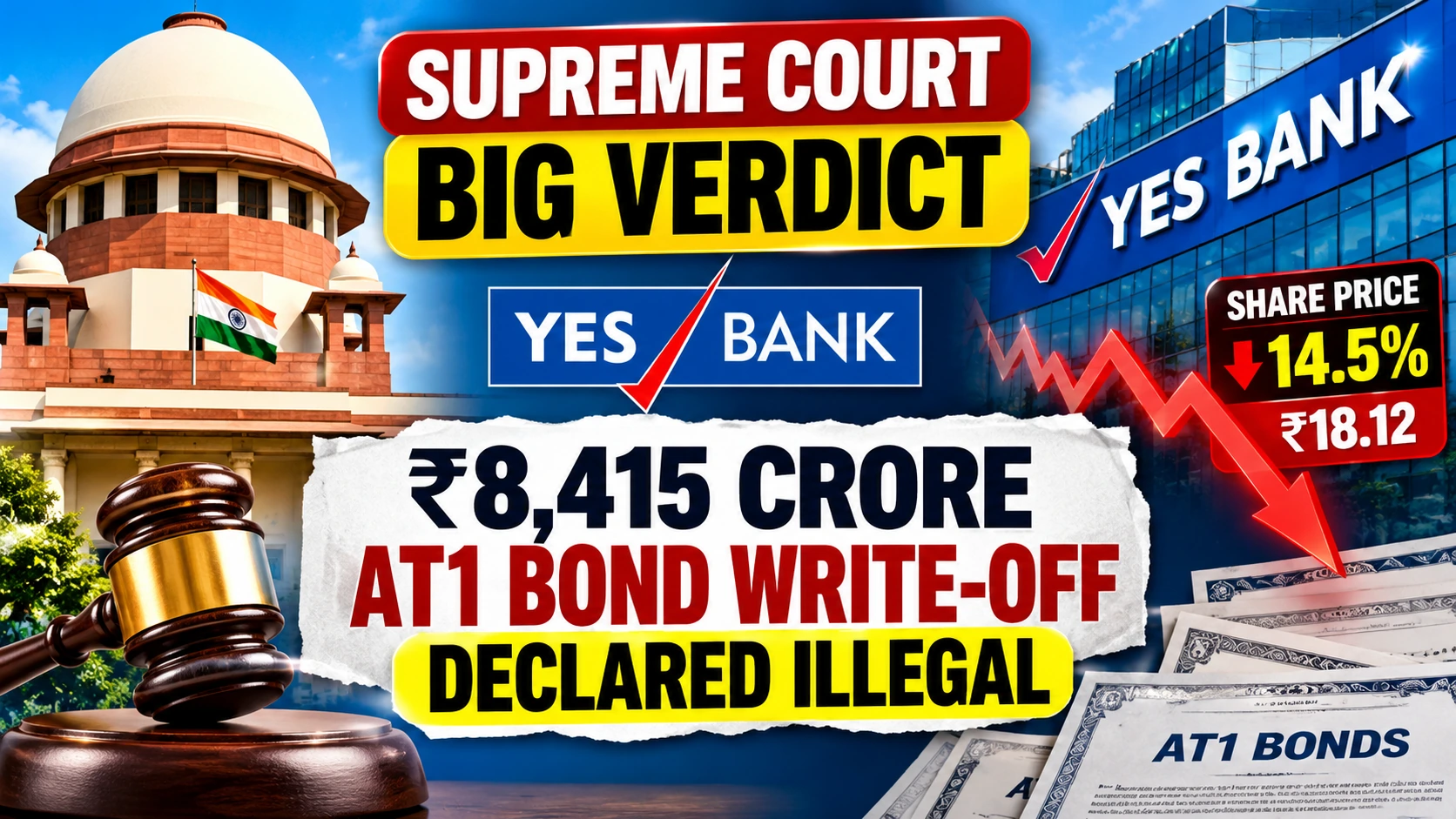
YES Bank AT1 Bond Verdict 2026: In a major judgment affecting India’s banking sector, the Supreme Court on October 15, 2026, upheld the Bombay High Court’s decision to invalidate YES Bank’s controversial Additional Tier-1 (AT1) bond write-off worth approximately ₹8,415 crore.
The ruling brings significant relief to investors whose bonds were written off during the bank’s financial rescue in March 2020.
However, the judgment also raises fresh concerns about YES Bank’s financial position, regulatory procedures, and the treatment of high-risk bond investors.
Following the decision, YES Bank shares fell approximately 14.5% to ₹18.12 on the National Stock Exchange on October 15.
Here is everything investors need to know about the judgment, its background, and its potential implications.
YES Bank AT1 Bond Verdict
Supreme Court Overturns the 2020 Bond Write-Off: Key Facts, Share Price Impact and Investor Details
📋 Complete Case Details
| Particulars | Details |
|---|---|
| Bank | YES Bank Limited |
| Bond Type | Additional Tier-1 |
| Disputed Value | Approx. ₹8,415 crore |
| Original Write-Off | March 2020 |
| Bombay HC Judgment | January 2023 |
| Supreme Court Ruling | 15 October 2026 |
| Decision | Write-off set aside |
| Key Legal Issue | Administrator’s authority |
| Bondholder Position | Legal relief granted |
| Cash Repayment | Not automatically immediate |
📅 Legal Case Timeline
👥 Who Is Affected?
The ruling invalidates the disputed cancellation and provides important legal relief.
The stock fell sharply amid concerns about the bank’s future financial obligations.
Restoring the bonds may affect financial reporting and regulatory capital.
The ruling reinforces the importance of lawful procedures and investor protection.
📉 YES Bank Share Price Impact
15 October 2026: Shares declined approximately 14.5%, reaching ₹18.12 on the NSE.
❓ Frequently Asked Questions
What did the Supreme Court decide?
It upheld the Bombay High Court’s decision setting aside the approximately ₹8,415 crore AT1 bond write-off.
Why was the write-off invalid?
The administrator lacked the necessary authority to write down the bonds under the final reconstruction scheme and applicable rules.
Will bondholders receive immediate refunds?
The ruling provides legal relief, but does not automatically confirm immediate cash repayment. Implementation and payment arrangements matter.
How did YES Bank shares react?
The shares fell approximately 14.5% to ₹18.12 on October 15, 2026.
Are AT1 bonds risk-free?
No. AT1 bonds are high-risk capital instruments that can absorb losses under specified conditions.
Does this ruling affect all AT1 bonds?
No. The judgment addresses the facts and legal procedures of this case. Other instruments remain subject to their applicable terms and rules.
⚖️ What Did the Supreme Court Decide?
The Supreme Court ruled that the administrator appointed during YES Bank’s 2020 financial crisis did not have the legal authority to write off the bank’s AT1 bonds in the manner used.
A bench comprising Justices Dipankar Datta and Augustine George Masih upheld the Bombay High Court’s 2023 judgment that had set aside the write-off.
The key issue was not whether AT1 bonds could ever absorb losses during a banking crisis. Instead, the court examined whether the correct legal powers and procedures had been followed.
The final YES Bank Reconstruction Scheme, 2020, did not include the provision allowing the administrator to write down the bonds.
The Supreme Court concluded that the administrator could not independently exercise powers reserved for the Reserve Bank of India under the applicable regulatory framework.
The ruling therefore invalidated the disputed write-off.
🏦 Why Were YES Bank AT1 Bonds Written Off in 2020?
YES Bank faced a severe financial crisis in early 2020 as bad loans, capital concerns, and weakening investor confidence threatened its stability.
The Reserve Bank of India intervened, imposed temporary restrictions, and appointed an administrator to manage the lender.
A reconstruction plan was subsequently introduced, with the State Bank of India and other financial institutions participating in the rescue.
During the restructuring process, approximately ₹8,415 crore worth of AT1 bonds were written off.
This effectively eliminated the value of those investments, causing major losses for institutional and individual bondholders.
The decision triggered legal challenges from investors who questioned both the administrator’s authority and the circumstances surrounding the sale of these securities.
📊 YES Bank AT1 Bond Case: Key Facts
| Particulars | Details |
|---|---|
| Bank | YES Bank Limited |
| Supreme Court verdict | October 15, 2026 |
| Disputed bond amount | Approximately ₹8,415 crore |
| Bond category | Additional Tier-1 (AT1) |
| Original write-off | March 2020 |
| Bombay High Court decision | January 2023 |
| Supreme Court outcome | Write-off set aside |
| Key legal issue | Administrator’s authority |
| YES Bank share price on October 15 | ₹18.12 |
| Share-price decline | Approximately 14.5% |
The case is important because it concerns both the legal treatment of investors and the procedures regulators must follow during bank reconstruction.
💰 What Are AT1 Bonds and Why Are They Risky?
Additional Tier-1 bonds are specialised debt instruments issued by banks to strengthen their regulatory capital.
Unlike ordinary fixed deposits, AT1 bonds carry significant risks.
They are generally perpetual securities, meaning they do not have a fixed maturity date. Banks may have call options allowing repayment under specified conditions.
AT1 bonds typically offer higher interest rates because investors accept additional risk.
If a bank experiences serious financial difficulties, these instruments can be converted into equity or written down when the applicable contractual and regulatory conditions are satisfied.
This loss-absorbing feature helps protect a bank’s financial stability.
However, the YES Bank judgment highlights that such powers must be exercised by the proper authority and through legally valid procedures.
👥 Major Relief for YES Bank AT1 Bondholders
The Supreme Court’s ruling is a significant legal victory for bondholders who challenged the 2020 write-off.
Individual investors, mutual funds, and other institutions were affected by the original decision.
The judgment restores their legal position by setting aside the disputed cancellation of the bonds.
However, investors should distinguish between winning the legal case and immediately receiving their entire investment in cash.
The precise financial implementation, payment arrangements, accounting treatment, and any remaining administrative steps require attention.
The court also addressed annual coupon payments, stating that they should follow the relevant bond information memoranda.
For affected investors, the ruling represents an important development after more than six years of uncertainty.
📉 Why Did YES Bank Shares Fall After the Judgment?
YES Bank shares came under heavy selling pressure on October 15, 2026, declining approximately 14.5% to ₹18.12.
Investors were concerned that restoring the AT1 bonds could create additional financial obligations and affect the bank’s regulatory capital position.
When the bonds were originally written off, the decision helped the bank absorb losses during its reconstruction.
Reversing that treatment could require financial adjustments.
The eventual impact will depend on accounting decisions, regulatory treatment, payment obligations, and the bank’s available capital.
A sharp one-day share-price decline does not establish how the stock will perform in the future.
Investors should avoid assuming that either a rebound or further losses are inevitable.
🏛️ Supreme Court Questions Regulatory Oversight
The judgment also raised serious concerns about the supervision of YES Bank before its financial collapse.
The court noted that the bank’s Common Equity Tier-1 capital ratio had fallen to approximately 0.6% by the end of 2019, far below the applicable requirement.
It questioned how the bank’s deteriorating position had been allowed to continue.
The court also criticised the sale of high-risk AT1 bonds to individual investors despite regulatory restrictions governing their distribution.
This aspect of the ruling is particularly important because retail investors may not always understand the complex loss-absorption features of AT1 securities.
The case highlights the need for stronger suitability checks, clearer risk disclosures, and effective regulatory supervision.
📅 YES Bank AT1 Bond Case Timeline
March 2020: YES Bank entered a major financial crisis, prompting regulatory intervention and a reconstruction scheme. Its AT1 bonds were written off.
January 2023: The Bombay High Court set aside the write-off, finding problems with the administrator’s authority.
2023–2026: YES Bank, the RBI, and the central government challenged the decision before the Supreme Court.
October 15, 2026: The Supreme Court upheld the Bombay High Court judgment, invalidating the disputed bond write-off.
📈 What Does the Verdict Mean for India’s Banking Sector?
The ruling could influence how banks, regulators, and investors interpret the legal requirements governing AT1 bonds.
These instruments remain an important part of banks’ capital structures.
However, the decision reinforces the principle that even during financial emergencies, regulatory powers must be exercised lawfully.
Banks may face greater scrutiny over AT1 bond disclosures, investor eligibility, and reconstruction procedures.
Investors may also demand clearer explanations of when and how their securities can absorb losses.
The judgment does not mean that all AT1 bonds are risk-free or that their loss-absorption provisions have been abolished.
❓ YES Bank AT1 Bond Verdict 2026: Frequently Asked Questions
1. What did the Supreme Court rule in the YES Bank AT1 bond case?
The court upheld the Bombay High Court’s decision setting aside the approximately ₹8,415 crore AT1 bond write-off carried out during YES Bank’s 2020 reconstruction.
2. Why was the write-off declared unlawful?
The administrator lacked the necessary authority to write down the bonds under the final reconstruction scheme and applicable regulatory rules.
3. Will YES Bank AT1 bondholders get their money back?
The judgment provides significant legal relief, but it should not be interpreted as confirmation of immediate cash repayment to every investor. Implementation details remain important.
4. How did YES Bank shares react?
The stock fell approximately 14.5% to ₹18.12 on October 15, 2026, following the judgment.
5. Are AT1 bonds safe investments?
AT1 bonds are high-risk banking instruments. They can absorb losses under specified conditions and should not be confused with ordinary fixed deposits.
6. Will this judgment affect other Indian banks?
It could influence regulatory practices, legal interpretations, and investor expectations. However, the outcome of any other case would depend on its own facts and applicable rules.
🎯 Conclusion: A Landmark Judgment for Bondholder Rights
The YES Bank AT1 Bond Verdict 2026 is a major development in India’s banking and financial regulatory landscape.
By invalidating the ₹8,415 crore write-off, the Supreme Court reinforced the importance of lawful procedures, regulatory accountability, and investor protection.
For bondholders, the decision offers substantial legal relief. For YES Bank, it creates financial and regulatory challenges that will require careful management.
The broader lesson is that banking stability and investor protection must operate within a transparent and legally sound framework.
Disclaimer: This article is for general information and education only. It does not constitute legal, banking, or investment advice. Financial securities involve risks, and investors should consult qualified professionals before making decisions.