

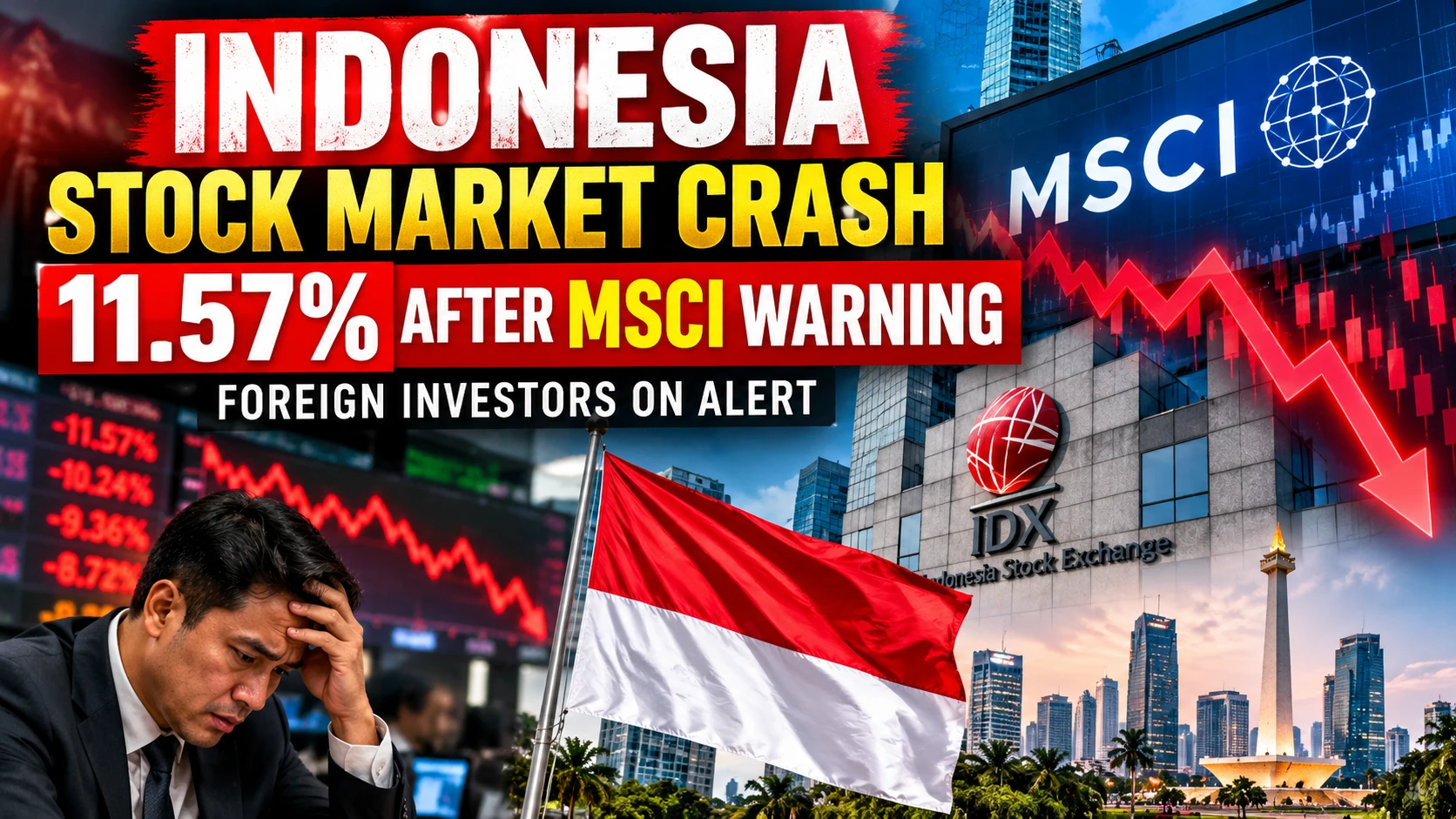
Indonesia Stock Market Crash:Indonesia’s stock market suffered its biggest single-day collapse in nearly 28 years on Friday, October 16, 2026, as the benchmark Jakarta Composite Index (JCI) plunged 11.57%. The sharp sell-off followed a warning from global index provider MSCI that Indonesia could lose its emerging-market classification.
The historic decline triggered a temporary trading halt, sent major banking stocks tumbling, and increased concerns about foreign investment in Southeast Asia’s largest economy.
The market turmoil has raised an important question: Could Indonesia’s potential removal from major global investment indexes trigger further financial instability?
📉 Indonesia Stock Market Records Worst Crash Since 1998
Indonesia’s financial markets witnessed extraordinary selling pressure on October 16, with the Jakarta Composite Index falling 678.68 points to close at approximately 5,185.11.
The 11.57% decline represented the market’s steepest single-day fall since January 1998, during the Asian financial crisis.
The index opened around 8% lower as investors reacted to MSCI’s announcement. Selling pressure quickly intensified, forcing the Indonesia Stock Exchange to temporarily suspend trading for approximately 30 minutes.
However, the decline continued after trading resumed.
The crash added to an already difficult year for Indonesian equities, with the benchmark index losing nearly 40% of its value since the beginning of 2026.
📊 Key Numbers From Indonesia’s Market Crash
- 11.57%: Jakarta Composite Index’s single-day decline.
- 5,185.11: Approximate closing level of the benchmark index.
- 1998: Previous period of comparable market turmoil.
- 30 minutes: Duration of the temporary trading halt.
- Nearly 40%: Approximate decline in the index during 2026.
- 18,070: Indonesian rupiah’s reported intraday level against the US dollar.
The figures illustrate the severity of the market reaction and the uncertainty surrounding Indonesia’s investment outlook.
📉 Indonesia Stock Market Crash
16 October 2026 | Market Performance Dashboard
📊 Market and Sector Declines
MSCI has proposed moving Indonesia from Emerging Market to Standalone Market status. The proposal is under consultation, with a final decision expected by June 2027.
Data: 16 October 2026. Bar scale: 0–15% decline. Values show reported market performance, not forecasts. The MSCI downgrade is a proposal, not a final decision.
🚨 Why Did Indonesia’s Stock Market Crash?
The immediate trigger was an announcement by MSCI, a leading global provider of investment indexes.
On October 15, MSCI launched a consultation proposing that Indonesia be reclassified from an emerging market to a standalone market.
This represents a potentially serious change for international investors.
Emerging markets are generally developing economies whose financial markets are sufficiently accessible and established to attract significant global institutional investment.
Standalone markets, by contrast, are not included in MSCI’s main emerging- or frontier-market index classifications.
A downgrade could therefore significantly affect Indonesia’s position in global investment portfolios.
⚠️ What Concerns Did MSCI Raise?
MSCI identified several longstanding concerns about Indonesia’s equity market, particularly regarding transparency and market functioning.
These include:
- Unclear ownership structures involving listed companies.
- Concentrated shareholdings that can limit freely traded shares.
- Suspected coordinated trading activity.
- Insufficient evidence of consistent regulatory enforcement.
- Concerns about the effectiveness of announced market reforms.
MSCI indicated that the progress made so far had not adequately addressed these problems.
The announcement unsettled investors because the proposed classification change could eventually reduce Indonesia’s representation in major international investment benchmarks.
🌍 What Is MSCI and Why Does It Matter?
MSCI is an international financial services company best known for creating stock market indexes used by investment managers around the world.
Its indexes help determine how institutional investors allocate money across countries, industries, and companies.
Exchange-traded funds, pension funds, and other investment vehicles often use MSCI benchmarks to guide their portfolios.
When a country’s classification changes, the consequences can extend beyond daily stock price movements.
For example, an investment fund tracking the MSCI Emerging Markets Index may need to sell securities removed from that benchmark.
That is why MSCI’s warning caused concern among foreign investors holding Indonesian shares.
However, the downgrade has not yet been finalized. The current announcement concerns a consultation and possible future reclassification.
💰 Could Foreign Investors Withdraw Billions From Indonesia?
One of the biggest concerns surrounding the Indonesia stock market crash is the possibility of large capital outflows.
If Indonesia loses emerging-market status, funds tracking relevant MSCI indexes may eventually have to reduce or eliminate their Indonesian holdings.
Some investment-bank estimates have suggested potential passive investment outflows of approximately $4 billion, with additional withdrawals possible from actively managed portfolios.
Combined estimates have indicated that the potential impact could exceed $19 billion.
These figures are projections, not confirmed withdrawals.
Actual outflows would depend on MSCI’s final decision, implementation arrangements, market conditions, and how international investors respond.
A substantial withdrawal of foreign capital could increase pressure on share prices and make it more difficult for Indonesian companies to attract international investment.
🏦 Major Indonesian Banking Stocks Come Under Pressure
Indonesia’s banking sector was among the hardest hit during the market sell-off.
Shares of major financial institutions, including Bank Central Asia, Bank Rakyat Indonesia, and Bank Mandiri, experienced significant declines as investors reduced their exposure to Indonesian equities.
Large banking stocks often represent important holdings in institutional investment portfolios.
When international investors become concerned about a country’s financial market, these heavily traded shares can face substantial selling pressure.
The widespread decline also reflected fears that uncertainty surrounding MSCI’s proposal could affect investor confidence beyond the stock market.
💵 Indonesian Rupiah Weakens Against the US Dollar
The stock market crash also affected Indonesia’s currency.
The Indonesian rupiah weakened during the trading session, reaching approximately 18,070 against the US dollar before recovering some ground.
Currency weakness can become an additional concern when international investors withdraw money from a country’s financial markets.
If investors sell local assets and convert the proceeds into foreign currencies, demand for the domestic currency may weaken.
A prolonged decline in the rupiah could increase the cost of imported goods and foreign-currency obligations.
However, currency movements are influenced by multiple factors, including monetary policy, global interest rates, trade flows, and broader investor sentiment.
🛡️ How Is Indonesia Responding to MSCI’s Warning?
Indonesian authorities have already introduced measures intended to improve market transparency and investor confidence.
These include enhanced disclosure requirements for shareholders holding more than 1% of a company’s shares, more detailed investor classifications, and reporting requirements for concentrated ownership.
Regulators have also outlined plans to increase minimum free-float requirements to 15%.
Free float refers to the proportion of a company’s shares available for public trading.
A higher free float can improve liquidity and make share prices less vulnerable to concentrated ownership.
Nevertheless, MSCI has emphasized that announced reforms must produce measurable and sustained improvements.
Indonesian officials have acknowledged the need for concrete progress to restore international investor confidence.
📅 When Will MSCI Make Its Final Decision?
MSCI’s proposed downgrade is subject to a consultation process rather than immediate implementation.
The consultation is expected to continue into April 2027, with a final decision scheduled by the end of June 2027.
During this period, Indonesian authorities have an opportunity to demonstrate improvements in market governance, ownership transparency, and regulatory enforcement.
Until further notice, MSCI’s existing freeze on certain index changes involving Indonesian securities remains in place.
The final decision will be closely watched by international fund managers and financial regulators.
🇮🇳 Could Indonesia’s Market Crash Affect Indian Investors?
The immediate impact on Indian stock markets is not necessarily direct.
However, Indonesia’s market turmoil could influence broader emerging-market investment sentiment.
Foreign institutional investors frequently compare opportunities across Asian markets, including India, Indonesia, Thailand, Malaysia, and Vietnam.
If investors become more cautious about emerging-market risks, regional fund flows could change.
Some markets might attract capital redirected away from Indonesia, while others could experience short-term volatility if investors reduce their overall exposure to emerging-market assets.
For Indian investors, the important indicators include foreign portfolio investment flows, Asian currency movements, and developments in international equity indexes.
🔮 What Happens Next for Indonesia’s Stock Market?
Indonesia’s financial market outlook will depend heavily on the government’s ability to address the concerns identified by MSCI.
Investors will watch whether authorities strengthen enforcement, improve ownership disclosures, and demonstrate that trading conditions have become more transparent.
The next several months could prove important for restoring confidence.
A credible reform program might reduce the likelihood of a downgrade, while continued uncertainty could maintain pressure on Indonesian assets.
The possibility of additional market volatility remains, but further losses are not inevitable.
❓ Frequently Asked Questions
1. Why did Indonesia’s stock market crash in October 2026?
The market plunged after MSCI proposed downgrading Indonesia from emerging-market to standalone-market status, citing concerns about transparency, ownership structures, and trading practices.
2. How much did the Jakarta Composite Index fall?
The Jakarta Composite Index declined 11.57% on October 16, 2026, its largest single-day fall since January 1998.
3. What does an MSCI downgrade mean for Indonesia?
A downgrade could remove Indonesian securities from important global investment benchmarks, potentially prompting investment funds to sell affected holdings.
4. Has MSCI officially downgraded Indonesia?
No. As of October 17, 2026, MSCI has proposed a downgrade and launched a consultation. Its final decision is expected by the end of June 2027.
5. Will the Indonesian stock market crash affect India?
There could be indirect effects through foreign investment flows and regional market sentiment, but the extent of any impact on Indian equities remains uncertain.
6. Can Indonesia’s stock market recover?
Recovery is possible if investor confidence improves and authorities demonstrate effective market reforms. However, the timing and extent of any recovery cannot be predicted reliably.
📝 Conclusion
The Indonesia stock market crash of October 2026 marks one of the country’s most significant financial market setbacks in nearly three decades.
The 11.57% plunge highlights investor concerns about market transparency, regulatory effectiveness, and the potential consequences of losing MSCI emerging-market status.
Although the proposed downgrade is not final, the warning has placed Indonesia’s financial authorities under considerable pressure to deliver meaningful reforms.
For global investors, the coming months will be crucial in determining whether Indonesia can restore confidence and maintain its position in major international investment indexes.